Prediction Market Prop Firms: How Polymarket and Kalshi Challenges Work, and What 8,266 Resolved Markets Show
Four prediction market prop firms compared, and what 8,266 resolved Polymarket and Kalshi markets show about passing a challenge.
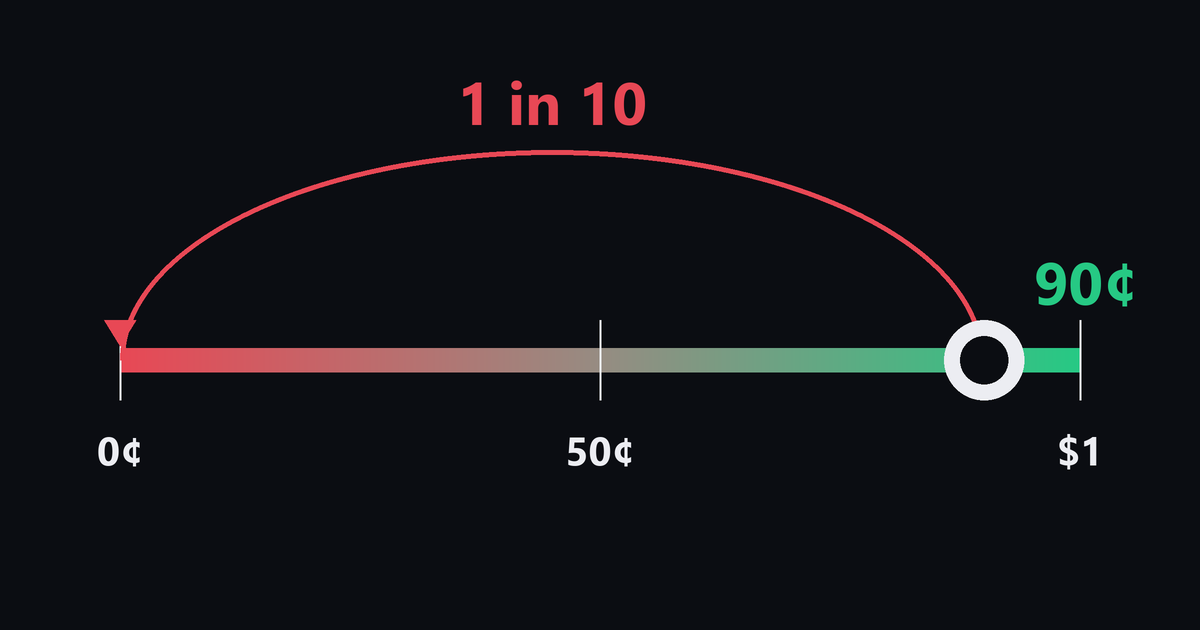
A prediction market prop challenge is a paid evaluation. You trade simulated Yes/No positions priced from Polymarket or Kalshi, and if you hit the profit target without breaking the loss limits, the firm gives you a funded account with a profit split. Most firms say the whole cycle is simulated. Binary contracts also make standard prop rules behave differently, and our data shows how.
Below we compare four firms' rules (checked on 23 October 2026) and test them on 8,266 resolved Polymarket and Kalshi markets. Melbo is a prediction market app and does not run challenges. "Prop" here means proprietary trading, not sports prop markets or California ballot propositions.
How do prop challenges on Polymarket and Kalshi work?
A prediction market prop challenge copies the forex and futures model, with event contracts in place of currency pairs:
- You buy an evaluation. A $10,000 account costs $80 to $139 at the firms that list a 10K price.
- You trade a simulated account priced from live Polymarket or Kalshi markets, within the firm's limits.
- Reach the target without breaking a rule, and you get a funded account with payouts on a fixed cycle and a 70% to 90% split.
- Break a rule, and the account closes.
The niche appeared between March and June 2026. Four firms publish full rules: Funding Predicts, PropMarket, Maven Trading and Lux Trading Firm. Propr sells separate Polymarket accounts, ForTraders has only run free beta competitions, and several smaller brands publish no rules. At least five call themselves the first, and we don't rank them. We found no prop firm that works only with Kalshi, and Kalshi runs no prop program of its own. Prop Account, the company behind PropMarket, also sells branded challenges to other operators (Finance Magnates), so more brands are likely.
Prediction market prop firms compared
Rules from each firm's own pages, checked on 23 October 2026. Funding Predicts figures are for the Standard plan unless noted.
| Funding Predicts | PropMarket | Maven Predictions | Lux Prediction Markets | |
|---|---|---|---|---|
| Price source | Polymarket | Polymarket and Kalshi | Kalshi or Polymarket (Match-Trade feed) | Not named |
| Profit target | 6% (Elite 12%) | 20% | 9% | 10%, closed positions only |
| Daily loss limit | 2% (Elite 3%) | None | None | None; risk up to 1% per topic |
| Max drawdown | 4% trailing, end of day (Elite 5% static) | 10% trailing from equity high, open positions included | 5% evaluation, 8% funded | 4% trailing from highest closed balance |
| Price limits | Entry at 85¢ or less | 20-80¢, resolving within 60 days | None stated | 10-90¢ |
| Position limits | 750 shares per event (10K); 30 open positions | None stated | Profit per question up to 3% of start balance | One trade per question; profit per trade up to 2x risk and 2% |
| Consistency | Best day up to 35% of cycle profit (50% on 10K) | One market up to 10% of total profit | None | None |
| Profit split | Up to 90% (Elite 80%) | 70%, or 90% as a paid add-on | 70% | 70%, then 80% from third payout |
| 10K price | $85 (Elite $105) | From $59 (size not stated) | $80-84 Essential, $133-139 Elite | 85 GBP, USD or EUR |
| Simulated or live | Simulated at both stages (Disclaimer) | Evaluation simulated; funded model not clearly disclosed | Simulated at both stages | Evaluation simulated; funded stage marketed as real money |
| Entity | Funding Predicts Holdings, Inc. (Delaware, US) | Prop Account, LLC (Florida) and Prop Account Cayman, LC | Maven Edu-FZCO (UAE) | Lux Trading Firm Ltd (UK) and Lux Trading Firm ME (UAE) |
Sources: Funding Predicts FAQ, homepage and Disclaimer; PropMarket; Maven product page and FAQ; Lux.
Sources disagree on the "simulated or live" row. Funding Predicts' Disclaimer says both stages are simulated, with no orders sent to Polymarket and no real capital, while payouts to traders are real money. A PropFirmMap review from July 2026 said the firm trades on real Polymarket order books; we go by the firm's own Disclaimer. Propr is the most explicit: each trade on its simulated account is a signal that the firm may copy to the live venue (A-book) or keep in house (B-book) (propr.xyz), and CryptoSlate reported that it copies about 5% of them.
Where do challenge prices come from? Polymarket and Kalshi in 2026
Challenge prices follow live Polymarket and Kalshi markets, so the venues' quoting, fees and settlement rules carry straight into a challenge.
How Polymarket and Kalshi contracts work
A share trades between $0 and $1, and its price reads as the market's probability. At resolution the right side pays $1 per share and the wrong side pays nothing (Polymarket docs, Kalshi docs).
Polymarket displays the midpoint between the best bid and ask, or the last trade when the spread is wider than 10¢. In the docs' example, a 34¢ bid and 40¢ ask show as 37¢, but you buy at 40¢ and sell at 34¢. On Polymarket a disputed resolution takes 4-6 days, and a market can resolve 50/50 at $0.50 per share (Polymarket docs).
What fees do Polymarket and Kalshi charge?
Polymarket charges takers C × feeRate × p × (1 − p), where C is the number of shares and p the price; makers pay nothing. The rate is 0.07 for crypto; 0.05 for sports, economics, culture and weather; 0.04 for politics, finance, mentions and tech; and 0 for geopolitics. At the 50¢ peak, 100 crypto shares cost $1.75 in fees (Polymarket fees, checked 23 October 2026). Polymarket US switched to a taker rate of 0.0695 for most markets on 19 October 2026 (Polymarket US fees).
Kalshi's taker fee is 0.07 × C × P × (1 − P), rounded up, about 1.75¢ per contract at 50¢, and some series apply a multiplier. The formula comes from secondary summaries of Kalshi's fee schedule (QuantVPS, Oddpool); we could not open the PDF itself. Kalshi's help center confirms maker fees on some markets.
Who can trade on Polymarket and Kalshi?
Kalshi is a US exchange overseen by the CFTC as a designated contract market. Polymarket US operates under an amended CFTC order of designation from 25 November 2025, with access through brokers (press release). The international, crypto-based Polymarket blocks seven sanctioned countries and regions outright and marks 37 more countries and provinces as close-only (exit allowed, no new positions), among them the US, the UK, France, Germany, Russia, Australia and Singapore (geoblock). A simulated challenge is not trading on Polymarket, so each prop firm sets its own country list.
How big are Polymarket and Kalshi?
Kalshi raised $1B at a $22B valuation in May 2026 (Business Wire) and was reportedly in talks at $40B in late September (Cointelegraph, citing Reuters). Bloomberg reported a $1B Polymarket round at $21B, led by 1789 Capital, in late August (Bloomberg Government); Polymarket has not announced it. The Block counted August volume at $37.17B for Kalshi and $8.16B for Polymarket (The Block); other trackers report far smaller totals. Sports were 83% of Kalshi's July volume, according to Barron's (Cointelegraph).
What changed in prediction market regulation in 2026?
Federal appeals courts split over Kalshi's sports contracts. The 3rd Circuit sided with Kalshi on 6 April at a preliminary stage (Holland & Knight); the 9th Circuit on 28 August and the 6th on 25 September held that state law applies (CoinDesk). New Jersey petitioned the Supreme Court on 2 September (Finance Magnates). Utah sued Kalshi on 20 October, and the Deseret News counted at least nine states that have taken legal action. The CFTC proposed a new event contracts rule on 10 June (CRS).
There were insider trading cases too: a US soldier was charged in April over Polymarket trades on the Maduro operation (WRVO), a Google engineer in May (TechCrunch), and Kalshi reported over 150 insider investigations in the first quarter (Al Jazeera).
How often does a "safe" favorite lose? Our data
About one time in ten. Favorites bought at 85-95¢ a day before the event lost 10.6% of the time on Polymarket (n = 699, 95% interval 8.5-13.1%) and 8.3% on Kalshi (n = 555, 6.3-10.9%), while their average price implied 9.7%. In the 90-95¢ band the rate was 7.9% on Polymarket (n = 391, about 1 in 13) and 6.6% on Kalshi (n = 317, about 1 in 15).
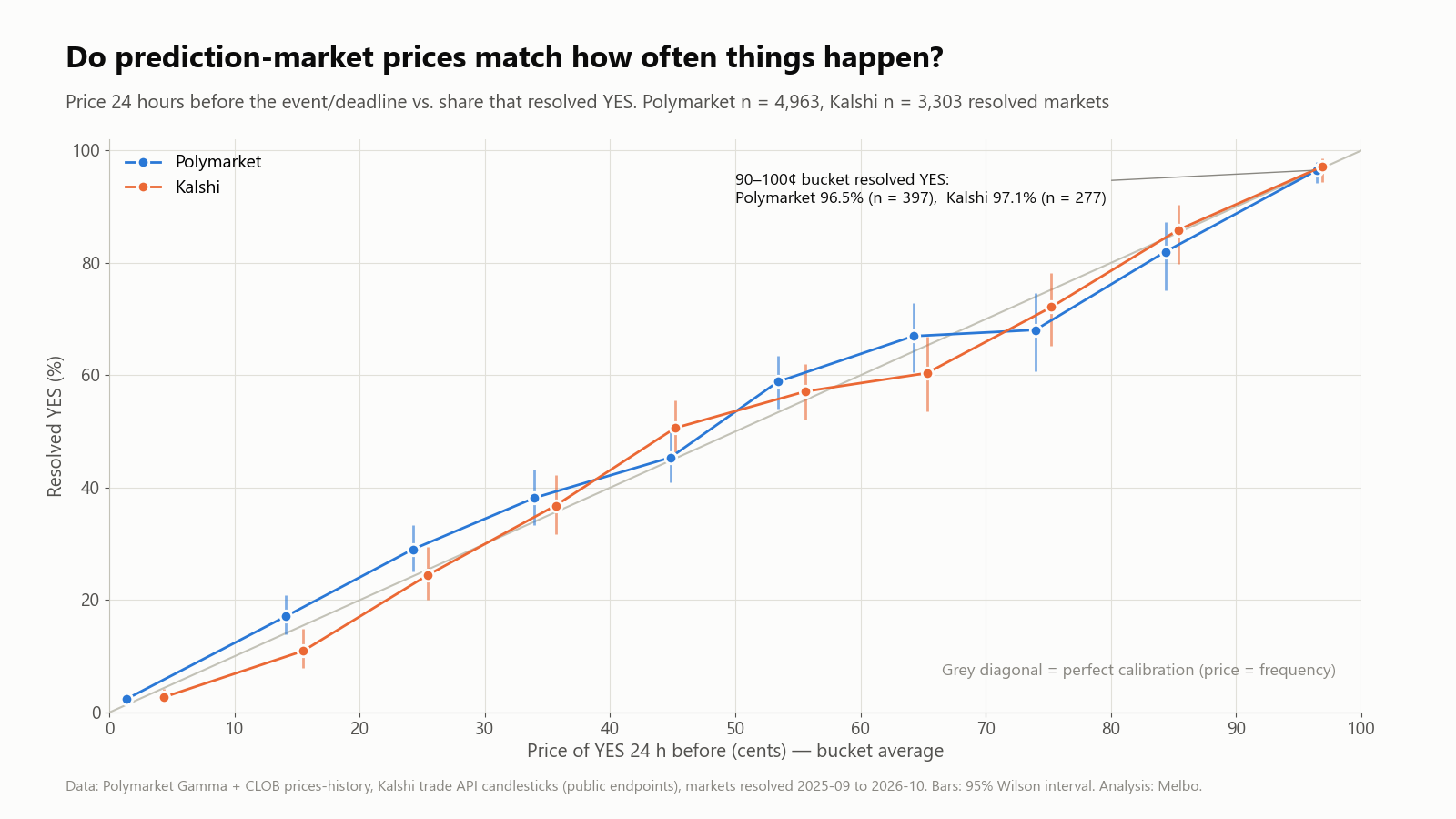
Prices are honest on average, and both calibration curves stay close to the diagonal. The exception is cheap Kalshi contracts. Those at 10-20¢ (average price 14.9¢) resolved Yes only 11.0% of the time, the favorite-longshot bias from our explainer.
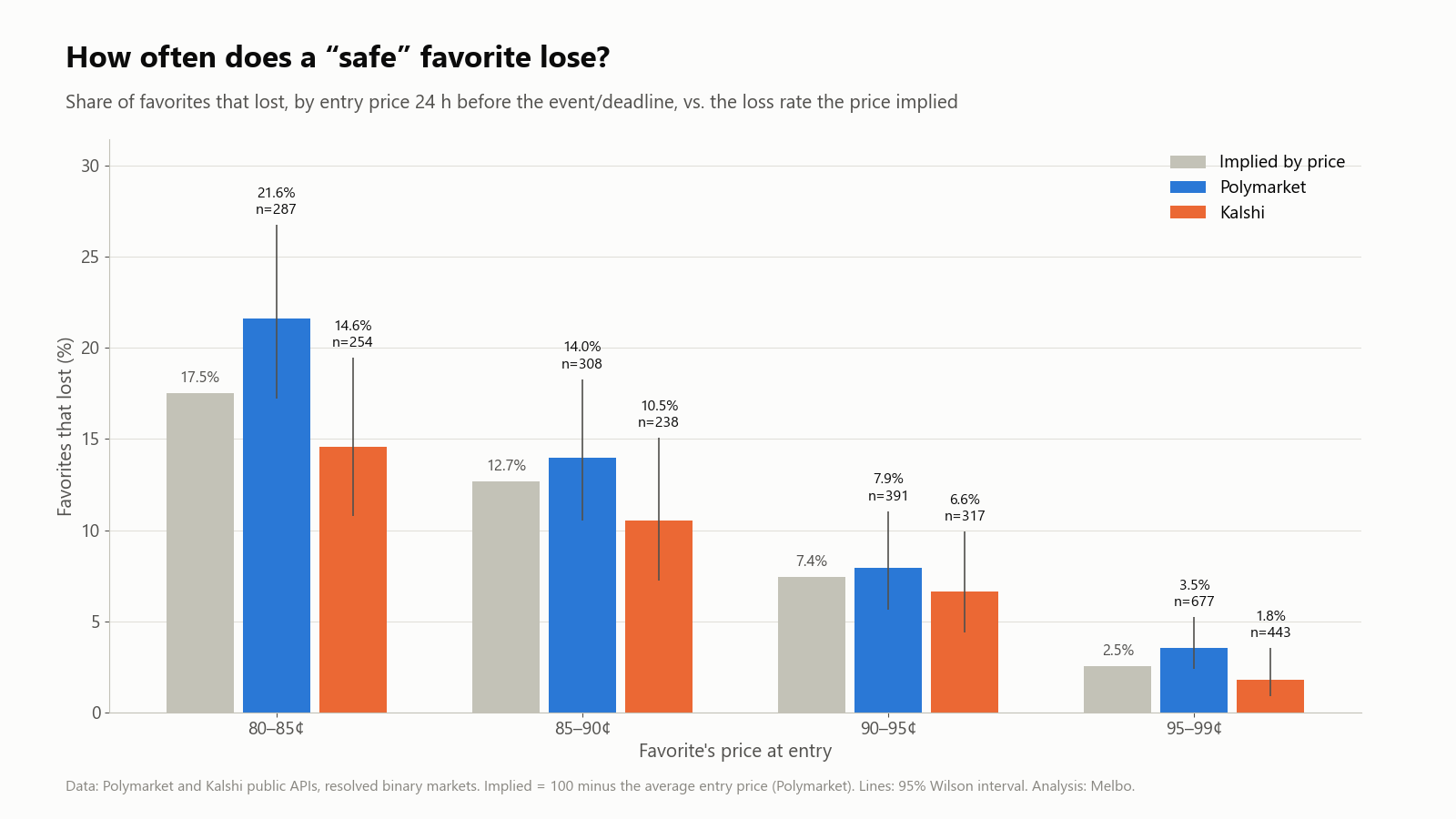
The larger categories agree: Polymarket sports favorites lost 11.7% (n = 179, implied 10.3%) and politics 11.0% (n = 173), while Kalshi sports lost 10.2% (n = 137), mentions 10.4% (n = 115) and weather 9.7% (n = 124). A 90¢ price means roughly what it says, so a challenge's trouble comes from the payoff and the limits.
How we collected the data
- Polymarket (public Gamma and CLOB APIs, hourly and 5-minute prices): closed markets with at least $10,000 in volume ending on days 8-14 of each month from October 2025 to October 2026. Of 92,617 markets, 50,077 qualified, and we drew a stratified random sample of 6,105.
- Excluded: 961 hourly crypto "Up or Down" markets, whose price a day before resolution is a 50¢ placeholder. Kalshi crypto is left out because its series are hourly and 15-minute markets with no 24-hour horizon.
- Kalshi (public trade API, hourly candlesticks): 47 series in six categories, closed 1 October 2025 to 15 October 2026, at least 10,000 contracts traded; 4,000 of 36,176 eligible markets sampled.
- Result: 4,963 Polymarket and 3,303 Kalshi markets at the 24-hour horizon (17 September 2025 to 15 October 2026).
- Entry price is the last price within three hours of the 24-hour mark (on Kalshi, the bid/ask midpoint when the spread is 10¢ or less). A favorite is the side priced at 50¢ or more.
- Caveats: the past year may not repeat, thin markets may behave worse, half of the Kalshi politics sample is daily Trump approval brackets, and Polymarket's price history does not say whether it records midpoints or trades.
Why can one upset end a prop challenge?
Because a binary contract pays $1 or $0, a favorite bought at 90¢ gains about 11% of the stake when right and loses all of it when wrong. After Polymarket's sports fee, one upset cancels about ten wins at any position size, while the loss limits stay fixed:
| Position size | One upset | One win | Upsets to hit a 5% daily limit | Upsets to hit a 10% drawdown | Upsets to hit FP's 2% daily limit |
|---|---|---|---|---|---|
| 1% | −1.0% | +0.11% | 5 | 10 | 2 |
| 2% | −2.0% | +0.21% | 3 | 5 | 1 |
| 5% | −5.0% | +0.53% | 1 | 2 | 1 |
At 5% per position, one upset fills a 5% daily limit; under Funding Predicts' 2% limit, a 2% position does. At our measured 10.6% upset rate, three favorites a day carry a 28.5% chance of at least one upset, and ten carry 67.3%.
Position caps don't always prevent this. Funding Predicts' Standard 10K allows 750 shares per event at up to 85¢, so a full position costs $375 at 50¢ and $637.50 at 85¢. A full position bought above about 27¢ that goes to zero breaks the $200 daily limit, and above about 53¢ it exceeds the whole $400 maximum drawdown. Lux caps money at risk at 1% per topic instead, Funding Predicts' Elite plan shrinks the share cap away from 50¢, and Maven caps profit per question at 3% while losses are bounded only by its 5% maximum.
Valuation matters too. In the Polymarket docs' example (34¢ bid, 40¢ ask), 750 shares bought at the 40¢ ask show −$22.50 at the 37¢ midpoint and −$45 at the 34¢ bid before fees: 11-22% of a $200 daily limit on entry. Fees peak at 50¢, where 750 crypto shares cost $13.13, or 6.6% of that limit. PropMarket counts open positions in equity, Funding Predicts applies its daily limit to equity, and Lux counts only closed positions. None of the four firms says publicly whether it values open positions at the midpoint, the bid or the last trade.
How much do prices move before a market resolves?
Often a lot, even when the favorite wins. Of 85-95¢ favorites that went on to win, 43% on Polymarket and 45% on Kalshi first traded at least 10¢ below entry, and 29% and 28% fell by 20¢ or more.
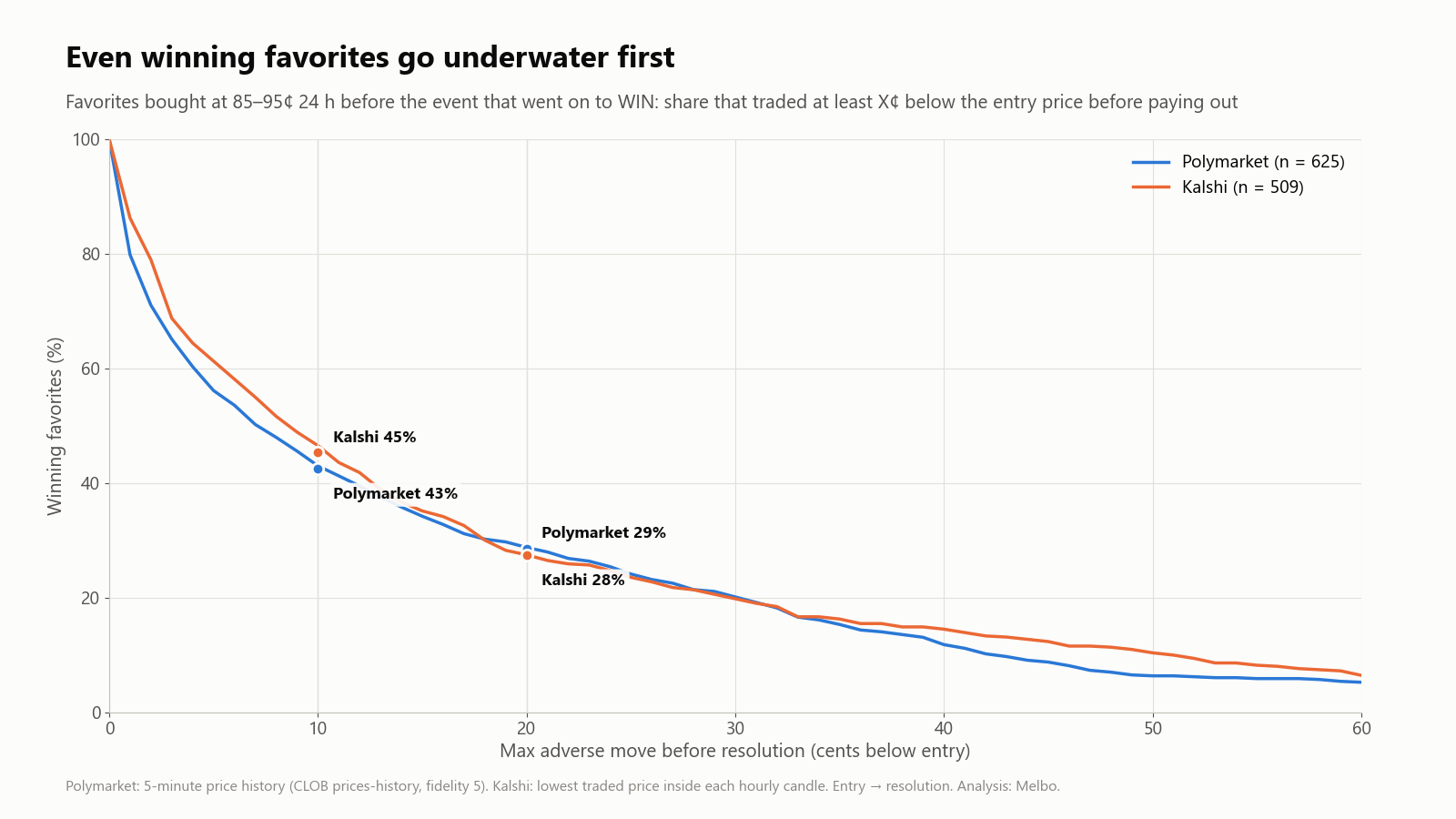
The median worst dip was 7.0¢ on Polymarket (n = 625) and 8.5¢ on Kalshi (n = 509); one winner in ten fell 42.5¢ and 50.6¢ or more. The dips were sustained: of 179 Polymarket winners that fell 20¢ or more, the median time below that level was 35 minutes, 42% stayed there an hour or longer, and 17% were a single 5-minute reading. Sports swing the most, following the game: winning sports favorites dipped a median 10.7¢ on Polymarket and 10.0¢ on Kalshi, against 5.8¢ and 2.0¢ for politics. If a firm counts open positions in equity, as PropMarket says it does, a position that ends up right can still break a limit on the way.
Losses arrive in jumps. A losing 85-95¢ favorite gave up at least half its price within a single hour 64% of the time on Polymarket (74 upsets) and 78% on Kalshi (46 upsets), with a median largest one-hour drop of 54¢ and 62¢. A daily loss limit records a gap like that after it happens and cannot prevent it. Both samples are small, so treat them as indicative.
Which simple strategies pass a prediction market prop challenge?
In our Monte Carlo simulation, the highest pass rates (42% to 59%) came from high-variance setups, such as cheap or mid-priced contracts or large positions, and no strategy had an expected value after costs clearly above zero.
We simulated a $10,000 account making three trades a day, each a real resolved market drawn at random from the strategy's price band, bought 24 hours ahead and held to resolution. Positions were 1%, 2% or 5% of the day's starting balance, with half a cent of spread plus taker fees on Polymarket and the actual ask plus fees on Kalshi. Each variant ran 20,000 times, with limits checked on the day-end closed balance; a stricter variant valued all open positions at their worst prices at once.
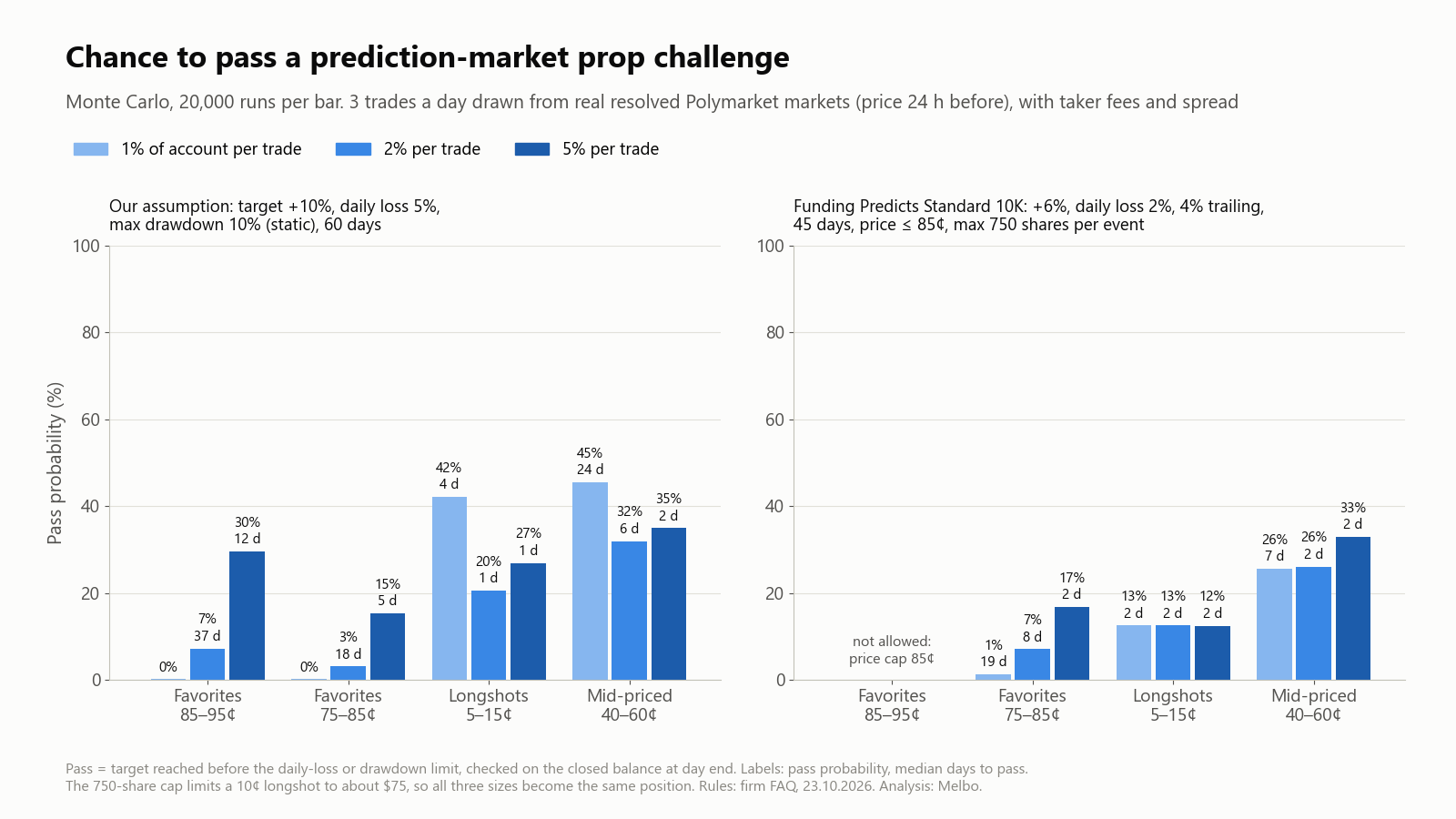
Under our generic rules (+10% target, 5% daily loss, 10% static drawdown, 60 days) on Polymarket:
- Favorites at 85-95¢ passed 0.1%, 7.2% and 29.6% of the time at 1%, 2% and 5% positions (Kalshi: 0.5%, 16.4%, 44.5%). At 1%, 90% of runs ran out of time; at 5%, worst-price valuation cut 29.6% to 4.0%.
- Longshots at 5-15¢ passed 42.2% of the time at 1%, with a median of four days.
- Mid-priced contracts at 40-60¢ passed 45.5%, 32.0% and 34.9%, and 58.5% at 1% on Kalshi.
Funding Predicts Standard 10K rules ban 85-95¢ favorites. There, favorites at 75-85¢ passed 1.3%, 7.0% and 16.7%, and mid-priced contracts 25.6%, 26.1% and 33.0%. A 50% consistency rule at the evaluation stage (the FAQ is contradictory on this) cuts mid-priced results to 24.2%, 11.7% and 11.0%; worst-price valuation cuts them to 6.0%, 6.0% and 8.4%.
Passing is not the same as making money. After spread and fees, the expected result per dollar was −2.0% for 85-95¢ favorites on Polymarket (interval −4.5% to +0.6%) and −0.3% on Kalshi (−2.8% to +2.2%), both indistinguishable from zero. Polymarket favorites at 75-85¢ returned −8.5% (−12.9% to −4.1%) and Kalshi longshots −33% (−55% to −11%). The mid-priced band's +1.2% and +3.9% were within noise.
High-variance strategies pass more often because the fee caps the trader's loss while the funded account is the upside: a few lucky days can reach the target before a steady strategy runs out of time. Price corridors, share caps, per-question profit caps (Maven 3%, Lux 2%), consistency rules and risk caps aim at this. With Maven's cap in our model, longshots passed only 0.1-0.3% of the time.
The model is simplified: it treats trades as independent, although same-evening games are often linked, ignores slippage beyond half a cent, liquidity, minimum trading days and payouts, and applies 2026 fees to the whole year. The results describe how the rules behave and are not a recommendation to trade any strategy.
How to check a prediction market prop firm before you pay
Read the Disclaimer and Terms as well as the homepage, and answer these questions:
- Simulated or live? Funding Predicts, Maven and Propr say all accounts are simulated; PropMarket and Lux don't clearly explain their funded stage.
- Who is the contract with, and under which law? Funding Predicts uses Delaware law, AAA arbitration and a class action waiver (Terms); Lux says it carries out no regulated activities.
- What are the payout caps? Funding Predicts Standard has a $100,000 lifetime cap per trader, and profit above a cycle's cap never becomes withdrawable. Lux caps payouts at 35%, 45% and then 50% of the starting balance.
- Is there a consistency rule? On a PropMarket 10K account, a $500 gain from one market raises the required total from $2,000 to $5,000.
- How are open positions valued? Ask support in writing: midpoint, bid or last trade.
- What happens in a resolution dispute? A disputed Polymarket market takes 4-6 days and can resolve 50/50, and Lux may void trades at erroneous prices even days after an event settles.
- Which price and share limits apply? Check the price corridor and per-event caps before you plan a position.
- Is your country restricted? Lists differ by firm; Funding Predicts', for example, includes Russia, Ukraine, Japan, Pakistan and Vietnam, and it bans VPNs. TradeInformer called simulated prediction market challenges "regulatory arbitrage" in March 2026, noting that the UK, the EU, Singapore and Australia bar retail binary options (TradeInformer).
- Has anyone been paid? Look for reviews with payout proof and dates; in a niche this young, many reviewers have not reached a payout.
Frequently asked questions
Is there a prop firm for Polymarket?
Yes. Funding Predicts, PropMarket, Maven Predictions and Propr sell evaluations priced from Polymarket, and Lux runs a similar product without naming its source. Polymarket runs none of them; Funding Predicts says its only link is Polymarket's builders program. Most simulate the evaluation, and several simulate the funded stage too.
Is there a Kalshi prop firm?
We found none that works only with Kalshi, and Kalshi runs no prop program. PropMarket prices from both Polymarket and Kalshi, and Maven's feed follows Kalshi or Polymarket. Either way, you trade a simulated account, not a Kalshi account.
Is Funding Predicts legit?
It is a Delaware company that publishes its rules and launched in June 2026, so its payout history is a few months long. MyFundedFutures holds an undisclosed stake (press release), its Disclaimer says trading is simulated, and payouts go through Rise every 7 days after Sumsub KYC. On 23 October it had 4.8 on Trustpilot from 75 reviews, mostly from traders not yet paid. The 4.9-star, 18,000-review figure on its homepage refers to MyFundedFutures.
Do prediction market prop firms trade real money?
Mostly no. Funding Predicts, Maven and Propr say all accounts, funded ones included, are simulated. PropMarket simulates the evaluation and does not clearly describe the funded stage, and Lux markets funded accounts as real money without explaining the mechanics. Payouts themselves are real money from the firm.
How do Kalshi fees work?
Kalshi charges takers about 0.07 × contracts × price × (1 − price), rounded up, peaking near 1.75¢ per contract at 50¢. Some series use a multiplier, and some markets charge makers. Polymarket uses the same formula with category rates. On Melbo, a market order costs 1% plus a liquidity fee, and limit orders are free (fees).
Can you get funded to trade prediction markets?
Yes. After you pass, the firm pays you a share of the funded account's gains, which are simulated at most firms, up to caps such as Funding Predicts' $100,000 lifetime limit. Under Funding Predicts' rules, our best simple strategy passed about a third of the time, and under 10% when open positions were valued at their worst price.
Why is a 90¢ share risky?
It gains 10¢ when right and loses 90¢ when wrong. In our data, 90-95¢ favorites lost about 1 time in 13 on Polymarket and 1 in 15 on Kalshi. Even among 85-95¢ favorites that won, 43-45% first fell 10¢ or more below the entry price.
Can I trade prediction markets with my own money instead?
Yes, where permitted. On Melbo you buy Yes or No shares with your own USDC on Polygon from $1, with no evaluation fee or drawdown rule; the most you can lose on a position is what you paid plus fees. Melbo is not available in restricted jurisdictions (Terms, section 3.2).
What to do next
New to binary contracts? Our guide to how prediction markets work explains price, payout and fees with examples. To trade prediction markets with your own funds, you can start on Melbo from $1 in USDC on Polygon.