Polymarket Trading Bots and 5-Minute BTC Markets: What 28,150 Resolved Windows Show
How Polymarket's short BTC markets settle, how bots trade them, and what 28,150 resolved windows show about fees, efficiency and bot risks.
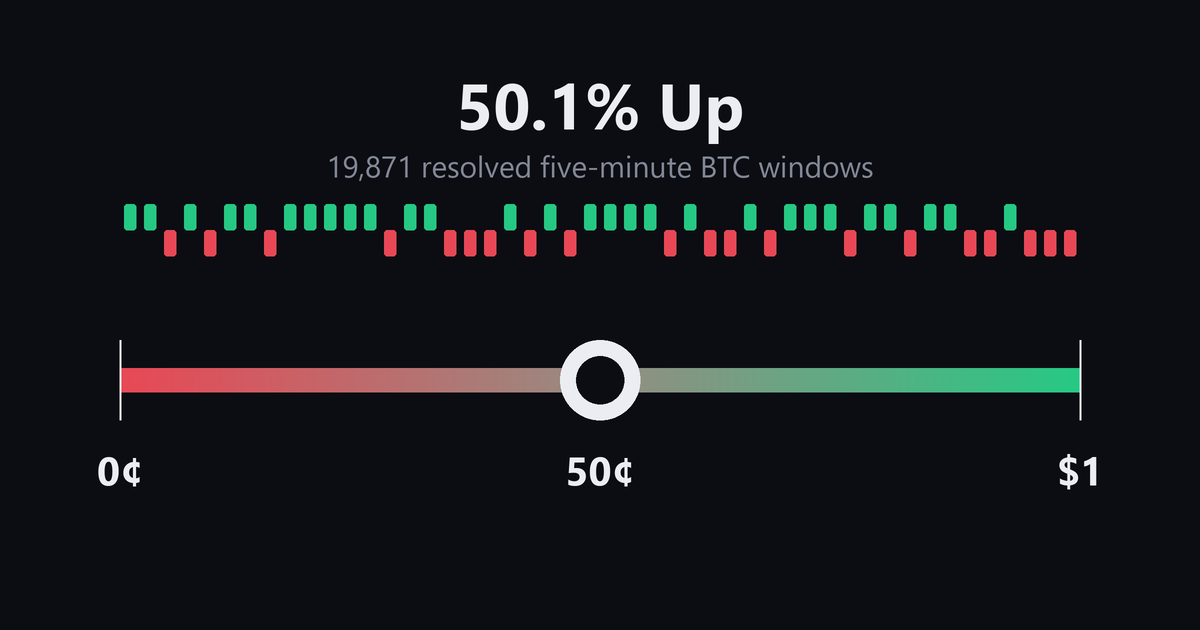
Polymarket trading bots handle most of the volume in the short "BTC Up or Down" markets, and in our analysis of 28,150 resolved windows these markets are close to efficient. Takers broke even before fees and lost about 2% of turnover after them, and buying the favorite in the final minute showed no reliable edge with real fills.
Melbo is a prediction market app and does not sell or run trading bots. Everything below is past data, not a forecast or a trading signal.
How do 5-minute BTC markets on Polymarket work?
Each Bitcoin Up or Down market asks whether BTC's price at the end of a fixed window will be at or above its price at the start. An Up share pays $1 if it is, a Down share pays $1 if it isn't, and a new market opens for every window around the clock. Polymarket runs BTC series for 5-minute, 15-minute, hourly, 4-hour and daily windows, with smaller ones for ETH, SOL and XRP.
Five-minute markets launched on 12 February 2026 with taker fees from launch (Polymarket changelog) and are now the busiest: on 23 October 2026 their 24-hour volume was about four times the 15-minute series and 19 times the hourly one (Gamma API).
That volume counts shares, matching the sum of fill sizes to the cent in our sample. The median 5-minute market traded $20,400 between takers in fills of about $4, and the whole 5-minute series turns over about $6 million a day while the interface shows about 13 million (our analysis of 28,150 markets, Melbo, Oct 2026).
What decides whether a market resolves Up or Down?
Since August 2026 the 5- and 15-minute markets compare two 60-second time-weighted average prices (TWAP) from Chainlink's BTC/USD stream, one at each end of the window, and ignore spot exchanges; hourly markets use a Binance candle (changelog, Chainlink TWAP stream).
| Market | Settles on | Resolves Up when | Exact tie | First traded |
|---|---|---|---|---|
| 5-minute | Chainlink BTC/USD, 60-second TWAP | closing TWAP is at or above opening TWAP | Up | 12 Feb 2026 |
| 15-minute | Chainlink BTC/USD, 60-second TWAP | closing TWAP is at or above opening TWAP | Up | 13 Sep 2025 |
| Hourly | Binance BTC/USDT 1H candle, via UMA | close is at or above open | Up | 28 May 2025 |
| Daily | Binance 1-minute candle at 12:00 ET | today's close is above yesterday's | 50/50 | 15 Mar 2025 |
Sources: Gamma API market rules (5-minute, hourly, daily) and the changelog.
What fees do Polymarket's crypto markets charge?
Takers on Polymarket crypto markets pay C × 0.07 × p × (1 − p), where C is the number of shares and p the price. Makers pay nothing and share 20% of taker fees as daily rebates (fees, maker rebates, checked 23 October 2026). The fee peaks at 50¢:
| Share price | Fee per share | % of money spent | Hit rate needed to break even |
|---|---|---|---|
| 50¢ | 1.75¢ | 3.50% | 51.75% |
| 80¢ | 1.12¢ | 1.40% | 81.12% |
| 90¢ | 0.63¢ | 0.70% | 90.63% |
| 95¢ | 0.33¢ | 0.35% | 95.33% |
| 99¢ | 0.07¢ | 0.07% | 99.07% |
Take 100 Up shares at 90¢: they cost $90 plus a 63¢ fee. If Up is right, the position gains $9.37; if not, it loses $90.63, which takes almost ten right calls to recover. Large takers pay less, because the taker rebate program returns 3% to 50% of fees by 30-day weighted volume, with crypto markets weighted highest (taker rebates).
How did Polymarket change these markets in 2026?
Several changes this year raised costs or added friction for fast takers:
| Date | Change | Source |
|---|---|---|
| 30 Mar 2026 | Fee Structure V2: the fee at 90¢ rises about 3.5 times, at 95¢ about 6 times | Crowdfund Insider; our calculation from archived docs |
| 28 Apr 2026 | CLOB V2: new exchange contracts, all open orders cancelled, old SDKs stop working | changelog |
| 7 and 14 Aug 2026 | Chainlink TWAP settlement for 5- and 15-minute markets; 60-second window for both | changelog |
| 4 Sep 2026 | Taker orders on crypto markets wait 150 ms before matching (250 ms earlier in the year, 50 ms from 17 August) | changelog |
How do Polymarket trading bots work?
A Polymarket bot is a program that reads market data and sends signed orders through Polymarket's public APIs: Gamma for markets and rules, CLOB for order books and orders, and the Data API for trades and wallet P&L. Websockets stream book updates and, since September 2026, the settlement TWAP (API overview).
Every order is signed with the wallet's private key, which also creates the API keys that sign each request, so a bot needs your private key or a session key. Session keys, still in beta, can trade but cannot withdraw funds, and they expire after 180 days (session keys). The main servers run in AWS London, and market makers can apply for colocation after KYC (infrastructure).
What strategies do bots run on BTC Up or Down markets?
- Market making. The bot quotes both sides near fair value and collects the spread plus maker rebates, at the risk of being filled just after Bitcoin moves.
- Latency or "oracle" trading. The bot watches Binance spot or the Chainlink stream and buys the side that should already be ahead before Polymarket quotes catch up. The 150 ms taker delay and TWAP settlement narrow this window.
- Late favorite. The bot buys the side priced at 90-99¢ in the final seconds and holds it to the $1 payout (tested below).
- Complete sets. When the best Up and Down asks add up to less than $1, buying both pays $1 at settlement, minus a fee on each leg. A study counted about $40 million of such arbitrage gains across Polymarket in the year to April 2025 (arXiv:2508.03474, Decrypt).
- Cross-venue trades between Polymarket's and Kalshi's hourly BTC contracts. If the two venues use different reference prices, the two legs can resolve differently.
- Copy trading. The bot mirrors a chosen wallet through the public Data API, arriving later and paying its own fee.
- AI agents built on language models, such as Polymarket's Agents framework, archived after November 2024. A model call takes seconds, slow for a 5-minute window.
GitHub lists 1,466 repositories created in the 60 days to 23 October 2026 that mention Polymarket, up from 267 a year earlier, and 986 that mention Kalshi (GitHub search), many of them dashboards, tutorials or clones with inflated stars.
Polymarket's current SDKs are the unified py-sdk and `@polymarket/client` (migration guide). The older py-clob-client, still used in many tutorials, is archived, and its README says it no longer works after CLOB V2.
Are BTC Up or Down markets efficient? What our data shows
Close to it. Every test we ran on 28,150 markets resolved from 14 August to 22 October 2026 found prices in line with outcomes.
Is Up or Down a coin flip?
Yes. Up settled 50.1% of the time in 5-minute markets (n = 19,871), 49.9% in 15-minute (n = 6,624) and 50.9% in hourly ones (n = 1,655). The previous result told nothing about the next: after an Up window, the next 5-minute market settled Up 49.6% of the time, after a Down window 50.6%. The longest runs of one result, 13 in a row for 5-minute and 16 for 15-minute markets, are about what a fair coin produces over that many flips (our analysis of 28,150 markets, Melbo, Oct 2026).
Does the price match the probability near the close?
Yes, within one or two points. A side priced at 80¢ or more one minute before the close was right 97.3% of the time in 5-minute markets at an average price of 96.1¢, 97.8% in 15-minute markets (97.2¢) and 98.3% in hourly ones (97.6¢). In 71% of 5-minute markets the favorite already traded at 90¢ or more at that point (our analysis of 28,150 markets, Melbo, Oct 2026).
Is Bitcoin's spot move already in the price?
Almost entirely. We built a simple estimate from Binance spot alone: the chance that the closing 60-second average ends above the opening one, given the move so far and the past hour's volatility. One minute before the close of 5-minute markets, its correlation with the market price was 0.98. The market matched the model's accuracy then and beat it in the last 30 seconds, with a Brier score of 0.016 against 0.023, lower being better (our analysis of 28,150 markets, Melbo, Oct 2026).
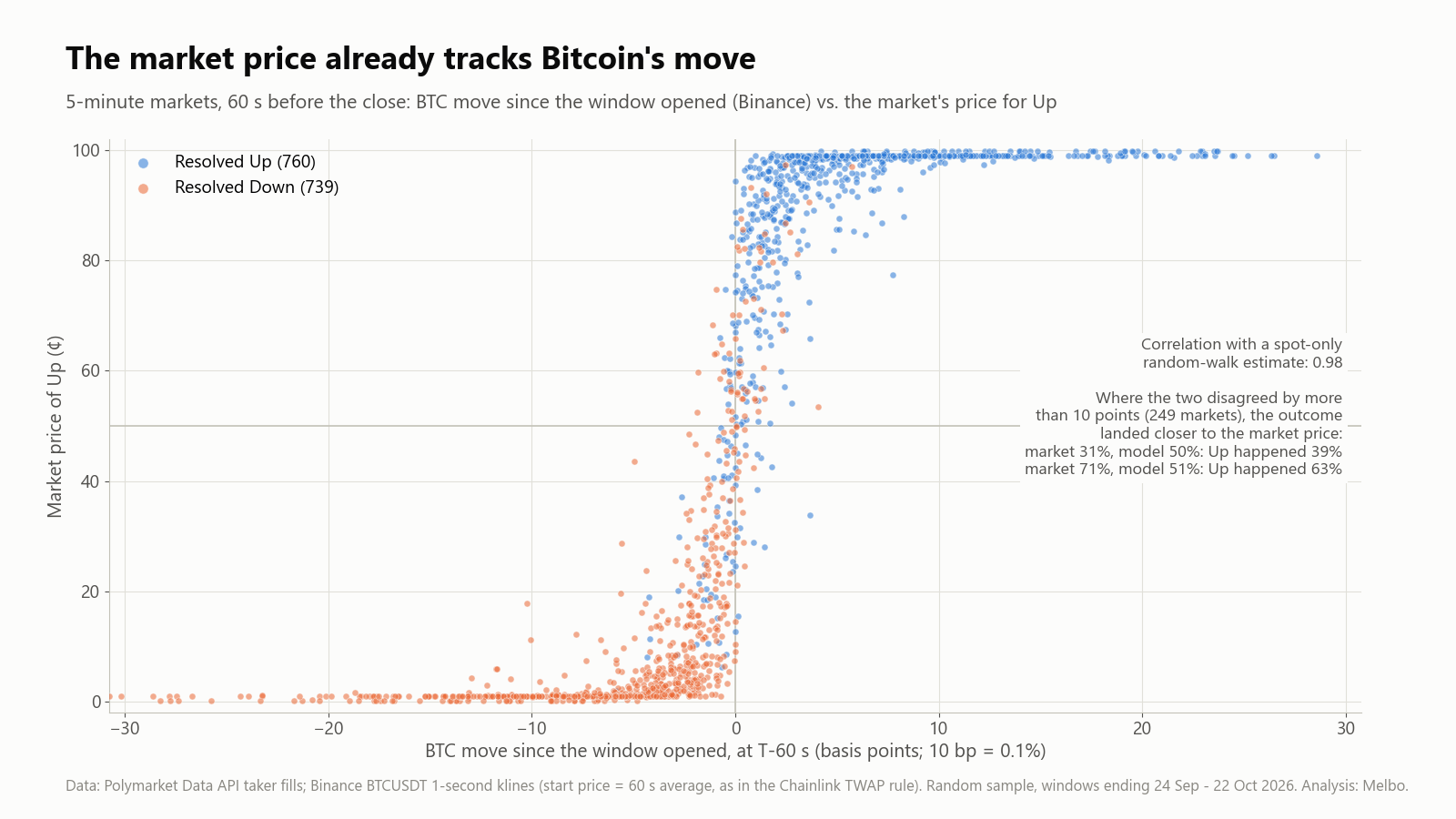
Where the market and the model disagreed by more than 10 points, the outcome landed closer to the market. What remains sits in the freshest quotes, where latency bots compete.
A bot that watches only Binance also tracks the wrong number. Our Binance version of the 60-second TWAP matched the Chainlink result in 97.9% of 5-minute windows and 98.3% of 15-minute ones, so about one window in 50 resolves differently from what Binance shows, usually when Bitcoin barely moved (our analysis of 28,150 markets, Melbo, Oct 2026).
Do Polymarket bots make money?
Some do, and takers as a whole lose about what they pay in fees. In our sample of 2,972 markets from the four weeks to 22 October 2026, takers' combined result before fees was −0.33% of turnover in 5-minute markets, +0.43% in 15-minute and −0.05% in hourly ones, each 95% interval including zero. After fees it was −2.21%, −1.81% and −2.29% (our analysis of 28,150 markets, Melbo, Oct 2026).
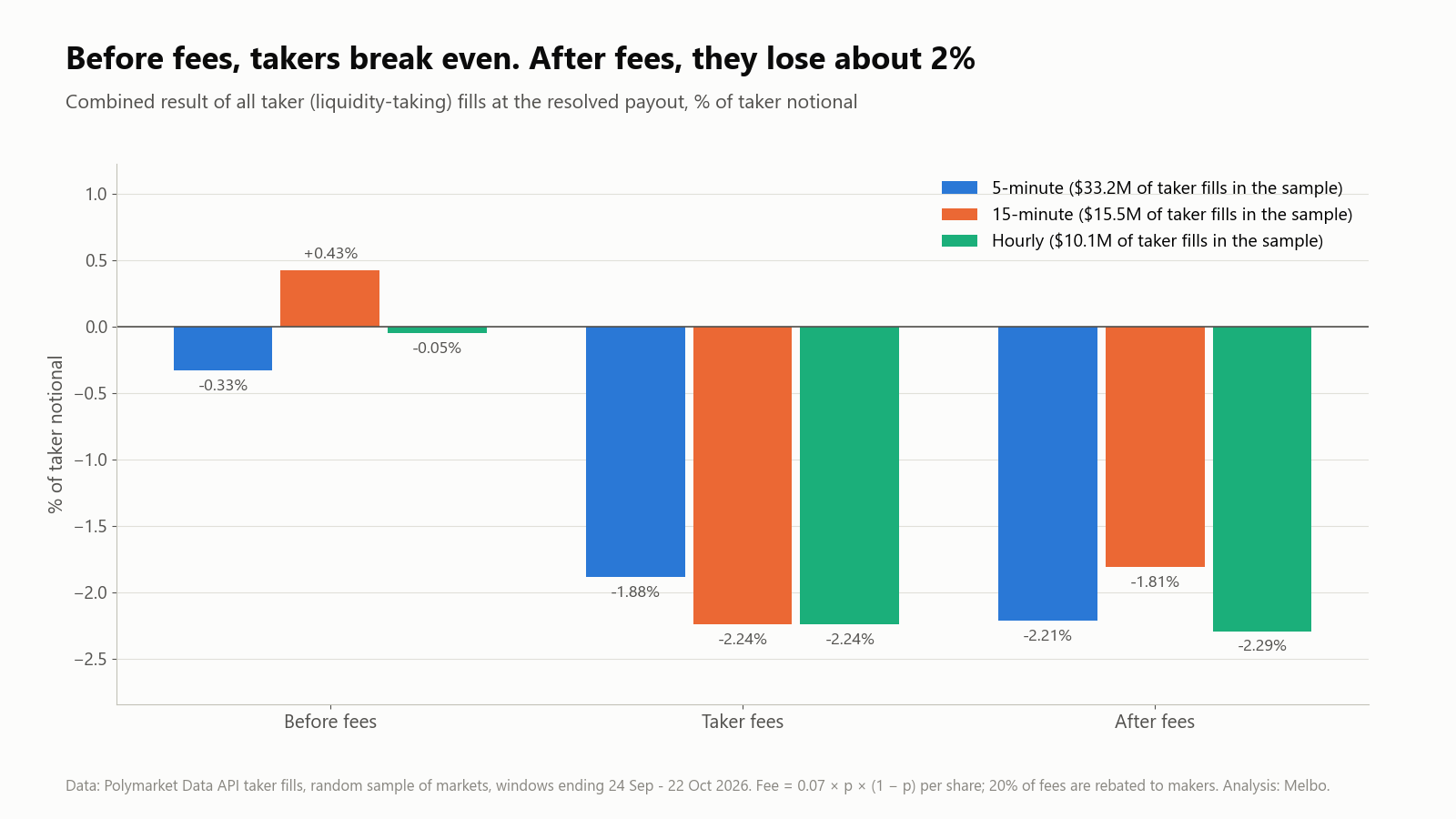
Prices are fair on average, so the fee decides the result. Makers, on the other side of each fill, net zero plus rebates worth about 0.4% of turnover.
Most of the volume comes from a few wallets. On 5-minute markets, 1% of taker wallets (299 of 29,901) made 57% of taker turnover. The 84 "always-on" wallets, which took liquidity in at least half of the sampled markets and are almost certainly automated, made 21.6% of turnover and finished at −0.12% after fees, while all other wallets lost 2.79%. On 15-minute markets the pattern reversed (−2.95% for 73 always-on wallets, −1.26% for the rest). These figures cover taker fills only, without maker income or taker rebates (our analysis of 28,150 markets, Melbo, Oct 2026).
Earlier on-chain studies point the same way. Telonex found that in one February 2026 week of 15-minute markets, 36.8% of 46,945 wallets ended ahead, the median wallet was down about $3, and takers lost $728,501 to makers before fees (Telonex). Dune classed bots as 55-62% of 5- and 15-minute volume from September 2025 to March 2026 (Blockchain.News, citing Dune). Takers lost even before fees in February and broke even in our October data, a sign of a more efficient market, though periods and methods differ.
The best-known bot story looks smaller in Polymarket's own data. A wallet reported in January to have turned $313 into about $438,000 in a month (Finbold) shows about $2.17 million of P&L on $200.6 million of volume in the Data API, roughly 1%, and stopped trading on 25 March 2026, five days before Fee Structure V2 (Data API). We could not verify the $313 starting balance.
Does buying the favorite in the last minute work?
Not reliably, once you count only trades that could be filled. The idea is to buy the side priced at 90¢ or more a minute before the close and collect $1. At 97¢, about 97.2% of positions must be right to break even, and favorites at that point are right 97-99% of the time.
We tested it two ways on the 2,972-market sample (our analysis of 28,150 markets, Melbo, Oct 2026):
- Real trades. All taker buys at 90¢ or more in the final 60 seconds returned +0.29% after fees on 5-minute markets (95% interval −0.57% to +1.03%) and +0.52% on hourly ones (−0.93% to +1.57%), both indistinguishable from zero. On 15-minute markets they returned +1.66% (+0.45% to +2.61%), the only clear positive, achieved by whoever managed to buy, mostly fast participants.
- A fixed rule. If the favorite is at 90¢ or more 60 seconds before the close, buy at the next real taker fill within 10 seconds, or skip the market. Only 39-41% of signals could be filled, and returns after fees were +0.60%, −0.23% and −0.09% (5-minute, 15-minute, hourly), with every interval crossing zero.
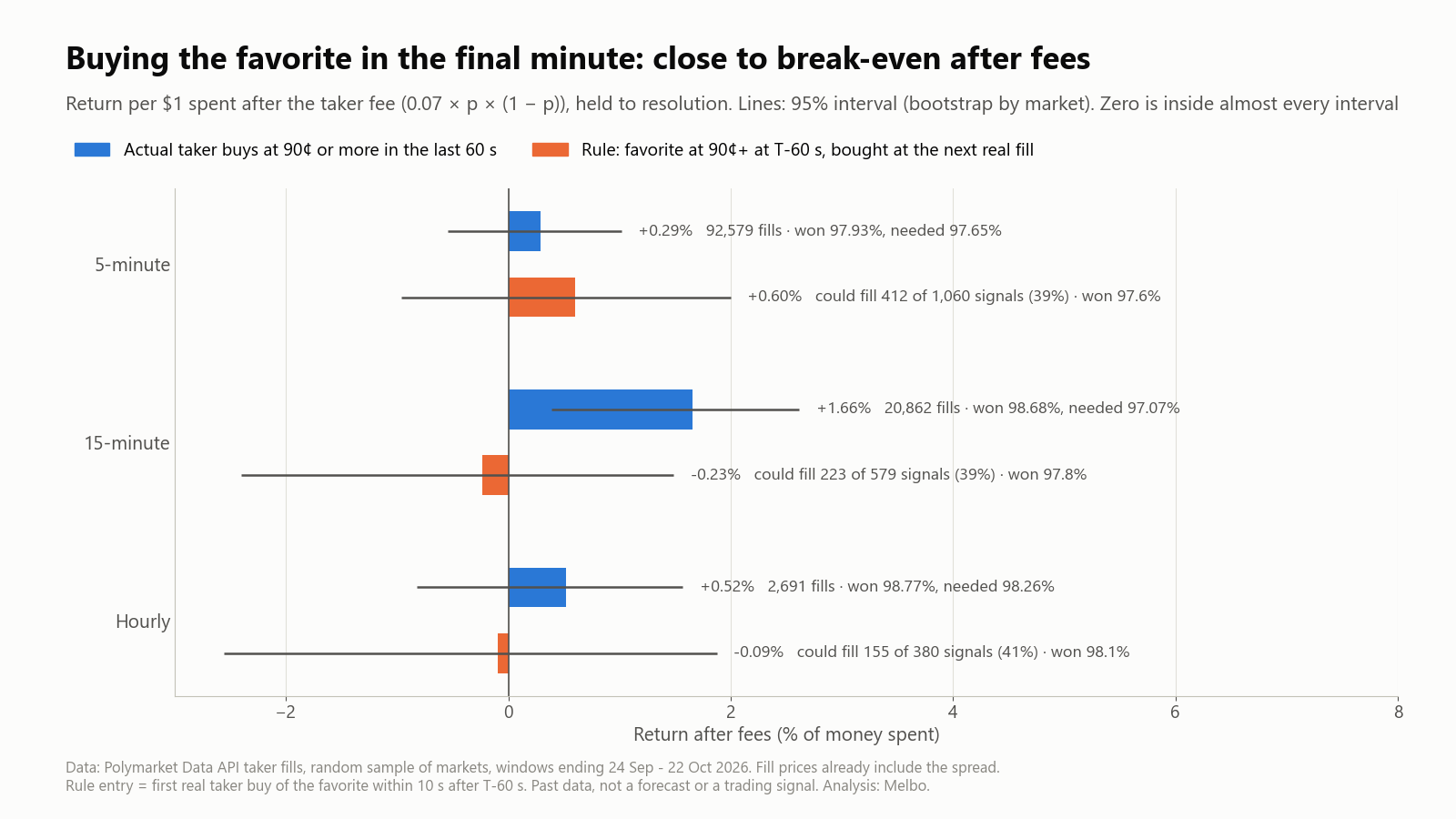
The best-looking result came ten seconds before the close of 5-minute markets: +3.9%, from only 29 of 1,459 signals (2%) that found a seller.
Why is there often nobody to buy from?
Near the close the favorite's side of the order book is usually empty. In our live snapshots of 5-minute markets, the favorite had no offers in 82% of snapshots taken 60 to 30 seconds before the close, 99% between 30 and 10 seconds and 100% in the last 10 seconds, sometimes with tens of thousands of shares bid at 99¢. When both sides were quoted, the median spread was 1¢ (Melbo order book snapshots, 23 October 2026).
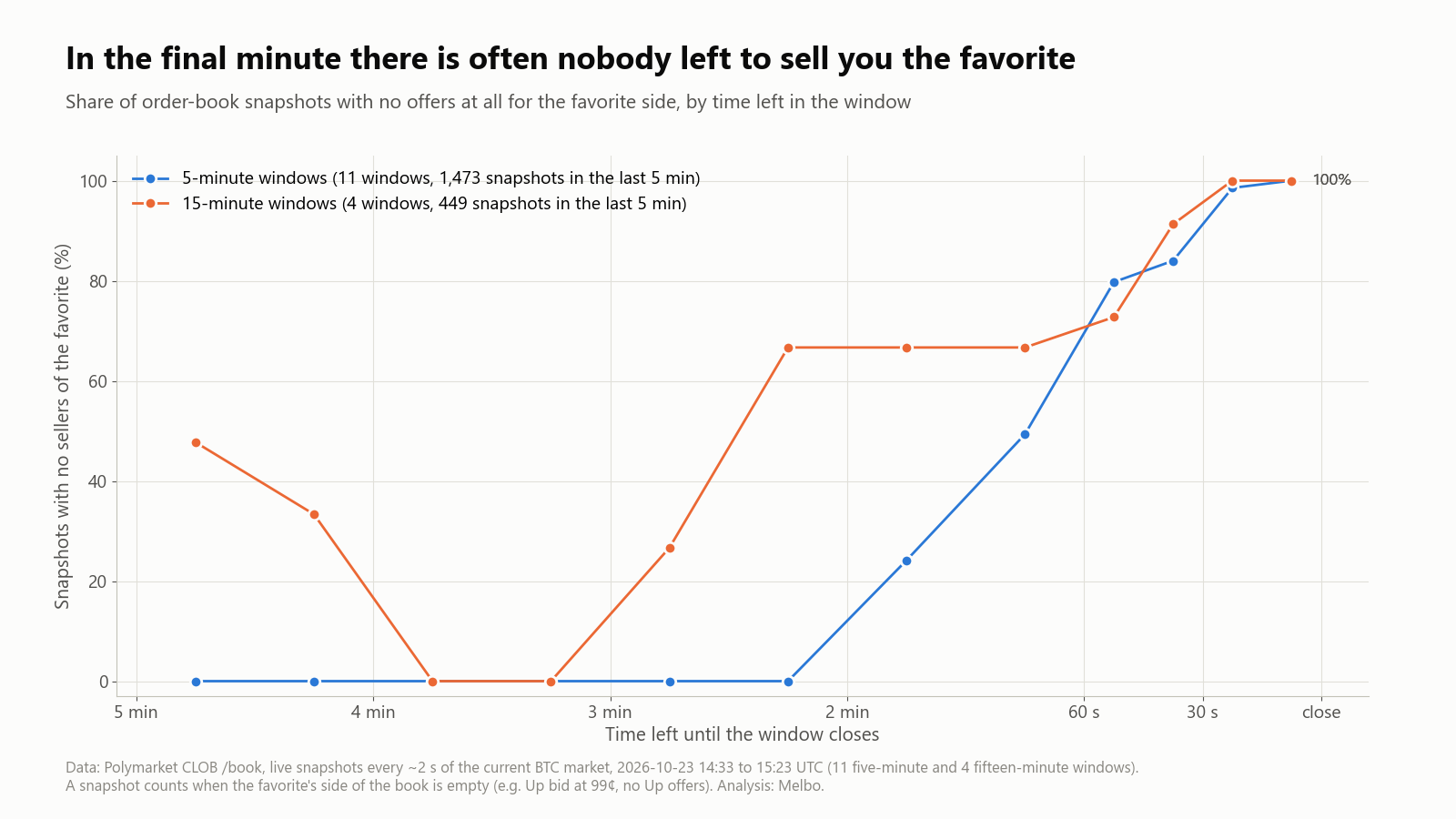
Trades confirm it: in 5-minute snapshots with no sellers, a purchase of the favorite followed within two seconds only 7% of the time, against 99.7% when sellers were present. The snapshots cover about 50 minutes (11 five-minute and 4 fifteen-minute windows), so treat these shares as indicative. The rare last-second fills look like stale orders a maker didn't cancel in time.
What are the risks of running or buying a Polymarket bot?
The largest practical risk is malicious code that steals your wallet; speed and settlement rules add smaller ones.
Stolen private keys and API keys
A bot signs orders with your wallet key, so a malicious one can empty the wallet, and Polymarket cannot access your key or reverse transactions (Terms). Researchers documented several cases in 2026:
- March: a hijacked, verified GitHub organization hosted 20+ clones of a working "Polymarket trading bot" with typosquatted npm dependencies that stole keys and installed an SSH backdoor (StepSecurity).
- April: the npm package `sleek-pretty`, posing as a logger, stole CLOB API keys and private keys; Panther linked it to a North Korean group (Panther).
- May: nine `polymarketdev` npm packages wrapped the real CLOB SDK and sent private keys to a remote server (OSV MAL-2026-4209).
- June: a fake arbitrage bot pulled `clob-client-math`, one of 30 packages from 10 npm accounts that stole wallets, browser passwords and SSH and AWS keys (SafeDep).
Scam bot sellers
Google suggests "polymarket bot for sale" and "polymarket trading bot telegram", and sellers serve that demand. Paid Telegram and copy bots usually ask for wallet access or a deposit, which hands your funds to a stranger. The cases above share warning signs: stars from bot accounts, keyword-stuffed descriptions, income promises, requests for your key or `.env` file, and unfamiliar npm dependencies.
Speed and settlement
A bot at home competes with colocated firms in London and waits 150 ms on every taker order. After a matching engine restart, only post-only orders are accepted for 2 minutes, 40% of a 5-minute window (matching engine). Settlement has its own traps:
- A tie settles Up in 5-minute, 15-minute and hourly markets; the daily market settles 50/50.
- The 5- and 15-minute markets settle on a 60-second Chainlink average at both ends, so comparing live spot with the opening price measures something else.
- Hourly markets settle through UMA and closed a median 12 minutes after the window ended in our period, against about one minute for 5- and 15-minute markets, so funds stay locked longer (Gamma API close times; our analysis of 28,150 markets, Melbo, Oct 2026).
- A Stanford and SMU study found bursts of spot order flow at the settlement moment of 5-minute BTC contracts, mostly at retail traders' expense, and almost none in 15-minute contracts (arXiv:2606.31675). Five weeks later Polymarket moved to TWAP settlement; it has not commented on any link.
Polymarket also limits users in restricted jurisdictions to closing positions, including through the API (geoblock).
Checklist before you run a Polymarket bot
- Use a separate wallet holding only what you can afford to lose, or a session key that cannot withdraw.
- Read the code and every dependency, install only the official SDKs, and treat unknown packages as suspect.
- Never paste a private key or seed phrase into a Telegram bot, a website or a repository you didn't write.
- Check that the code targets CLOB V2; anything built on `py-clob-client` no longer works.
- Put the fee, 0.07 × p × (1 − p) per share, and about half a cent of spread into every estimate.
- Know each market's settlement source and its tie rule.
- Run at the 5-share minimum for a week and compare the bot's log with your Data API fills.
- Use Polymarket's heartbeat feature or a kill switch so open orders are cancelled if the bot disconnects.
- Stay within the Terms, including the bans on wash trading, spoofing and VPN use.
How we collected the data
- Markets: all 28,150 resolved BTC Up or Down markets with windows ending 14 August to 22 October 2026 (19,871 five-minute, 6,624 fifteen-minute, 1,655 hourly), from the public Gamma API, all under one regime (fee rate 0.07, 60-second Chainlink TWAP, Binance 1H for hourly).
- Trades: all 3.56 million taker fills in a random sample of 2,972 markets ending 24 September to 22 October 2026 (1,500 five-minute, 800 fifteen-minute, all 672 hourly), from the Data API. The price at a moment is the volume-weighted fill price in the preceding 15 seconds; intervals are bootstrapped by market.
- Spot: Binance BTCUSDT 1-minute and 1-second candles. Replaying hourly outcomes from Binance matched all 1,655 markets.
- Order books: 4,419 live snapshots, about every 2 seconds, on 23 October 2026, 14:33 to 15:23 UTC.
- Caveats: one fee and settlement regime, so results don't carry over to early 2026. Prices come from fills, since the public API keeps no historical book, and fills were checked only at small sizes (median $4-7). "Bot" is our label based on behavior, and we don't publish wallet addresses.
Frequently asked questions
Do Polymarket bots actually work?
Bots run fine; making money with them is the hard part. In our sample of 2,972 BTC Up or Down markets, takers broke even before fees and lost about 2% after. The 84 always-on wallets on 5-minute markets finished near zero (−0.12%), and a February study found 36.8% of wallets ahead in a week.
Are bots allowed on Polymarket?
Yes. Polymarket's Terms of Use, effective 11 August 2026, treat API access as a normal way to use the service and do not ban automated trading. They prohibit wash trading, spoofing, front-running, overloading the service, scraping the website and using a VPN to get around restrictions, and Polymarket's integrity policy says it can ban wallets.
What happens if the BTC price doesn't change in a 5-minute market?
The market resolves Up, because the 5-minute, 15-minute and hourly rules count a closing price at or above the opening price as Up. Since August 2026 the 5- and 15-minute markets compare 60-second Chainlink averages, which makes an exact tie less likely. Daily markets settle 50/50 on a tie.
What are the fees on Polymarket 5-minute and 15-minute markets?
Takers pay 0.07 × shares × price × (1 − price): 1.75¢ per share at 50¢, or 3.5% of the money spent, and 0.63¢ at 90¢, or 0.7%. Makers pay nothing and share 20% of taker fees. On Melbo, a market order costs 1% plus a liquidity fee, and limit orders are free (fees).
Are Polymarket bots on GitHub or Telegram safe?
Many are not. In 2026 security firms documented fake Polymarket bots and npm packages that stole private keys, API keys and passwords, often from repositories with inflated stars. Read every dependency, use a separate wallet or a session key that cannot withdraw, and never give anyone your private key.
What is the best strategy for BTC Up or Down markets?
Our data shows no simple strategy with a reliable edge after fees. Outcomes were 50/50, prices near the close matched results, and buying 90¢ favorites in the last minute came out near zero, often with no sellers. Most of the difference between groups of wallets came from costs. This is past data, not a trading signal.
Can you copy-trade on Polymarket?
Technically yes. Every wallet's trades are public through the Data API, and GitHub lists 1,145 repositories created since late August 2026 that mention Polymarket copy trading in their README. In a 5-minute market the copy fills later and pays its own taker fee, and many paid copy bots ask for access to your wallet.
Does Melbo offer trading bots?
No. Melbo is a prediction market app where you buy and sell Yes or No shares yourself, starting from $1 in USDC on Polygon. It does not sell, run or recommend trading bots. Melbo is not available in restricted jurisdictions (Terms, section 3.2).
What to do next
If you are new to prediction markets, our guide to how prediction markets work explains price, payout and fees with examples, and our piece on prediction market prop firms tests challenge rules on 8,266 resolved markets. To trade prediction markets with your own funds, you can start on Melbo from $1.