Fed Meeting December 2026: What Bitcoin Did in the Hour After Every Fed Decision Since 2018
We checked bitcoin's price minute by minute after every scheduled Fed decision since 2018. The hour after the statement swings two to three times more than a normal hour, the direction is close to a coin flip, and the press conference brings as much movement as the decision itself.
The Federal Reserve announces its next interest rate decision on Wednesday, December 9, 2026, at 2:00 p.m. EST (19:00 UTC), and Chair Kevin Warsh holds a press conference at 2:30 p.m. We checked what bitcoin did in the hour after each of the 70 scheduled Fed decisions from January 2018 to October 2026, using one-minute prices. Since 2021, bitcoin's high-to-low range in that hour has been about three times its usual range at the same time of day. The direction has been close to a coin flip: up after 38 decisions, down after 32.
Here is what we found:
- The hour after the statement is busy. Bitcoin's range in the first hour had a median of 1.5%, against 0.7% at the same hour on normal days. Since 2021 the range was wider than normal after 46 of 47 decisions.
- The direction is not predictable from the decision. After rate hikes bitcoin rose in the first hour 8 times out of 16, after cuts 3 times out of 9.
- The press conference matters as much as the statement. The half hour after 2:30 p.m. was as volatile as the half hour after 2:00 p.m., and in 46% of meetings it went the other way.
- Hikes bring the biggest swings. The median first-hour range after a hike was 3.1%, about four times normal. December 9 is expected to bring the second hike of 2026.
When is the Fed meeting in December 2026?
The Federal Open Market Committee (FOMC) meets on December 8 and 9, 2026 (Federal Reserve calendar). The decision comes out on Wednesday, December 9:
| Event | New York (EST) | UTC |
|---|---|---|
| Policy statement | 2:00 p.m. | 19:00 |
| Press conference | 2:30 p.m. | 19:30 |
| Minutes of the meeting | December 30, 2:00 p.m. | 19:00 |
It is one of the four meetings a year with a Summary of Economic Projections, including the "dot plot" of where each official expects the rate to go. The Fed's quiet period, when officials do not comment on policy, runs from November 28 to December 10 (Fed communication rules).
Time zones catch people out. In summer the statement comes at 18:00 UTC, in winter at 19:00 UTC, because New York switches between daylight and standard time. On December 9 it is 19:00 UTC, 20:00 in Berlin and midnight in Almaty, when it is already December 10 there.
What is the Fed expected to do on December 9?
Markets expect a rate hike. On September 16, 2026, the Fed raised its target range by 0.25 percentage points to 3.75–4.00%, its first hike since July 2023, and in its September projections 16 of 18 officials saw at least one more hike this year (September projections). In October the Fed held the rate, but two of the twelve voters wanted another hike.
- Inflation is the reason. Consumer prices rose 0.4% in October and core prices 0.3% (BLS, November 10). Core PCE inflation was 3.1% a year in September (BEA).
- Officials are talking about it openly. Governor Christopher Waller said on November 10 he was "leaning toward supporting an increase in our policy rate of 25 basis points" in December, and that a 50-point hike "should be considered" if core inflation came in around 0.3% or higher (speech).
- Futures price a hike. After the October inflation report on November 10, the CME FedWatch tool, which reads probabilities from fed funds futures, showed 88.8% for a 0.25-point hike and 11.2% for a 0.50-point hike (CME FedWatch).
Two data releases come before the decision: October PCE inflation on November 25 and November jobs on December 4. November consumer prices come out on December 10, the day after the decision.
The meeting will also look different from the ones in most of our data. Kevin Warsh became chair on May 22, 2026 (Federal Reserve). Under him the statement is about half as long, the vote is published as a count with only the dissenters named, and the press conference runs about 30 minutes with one question per reporter (Axios).
How does bitcoin react to a Fed decision?
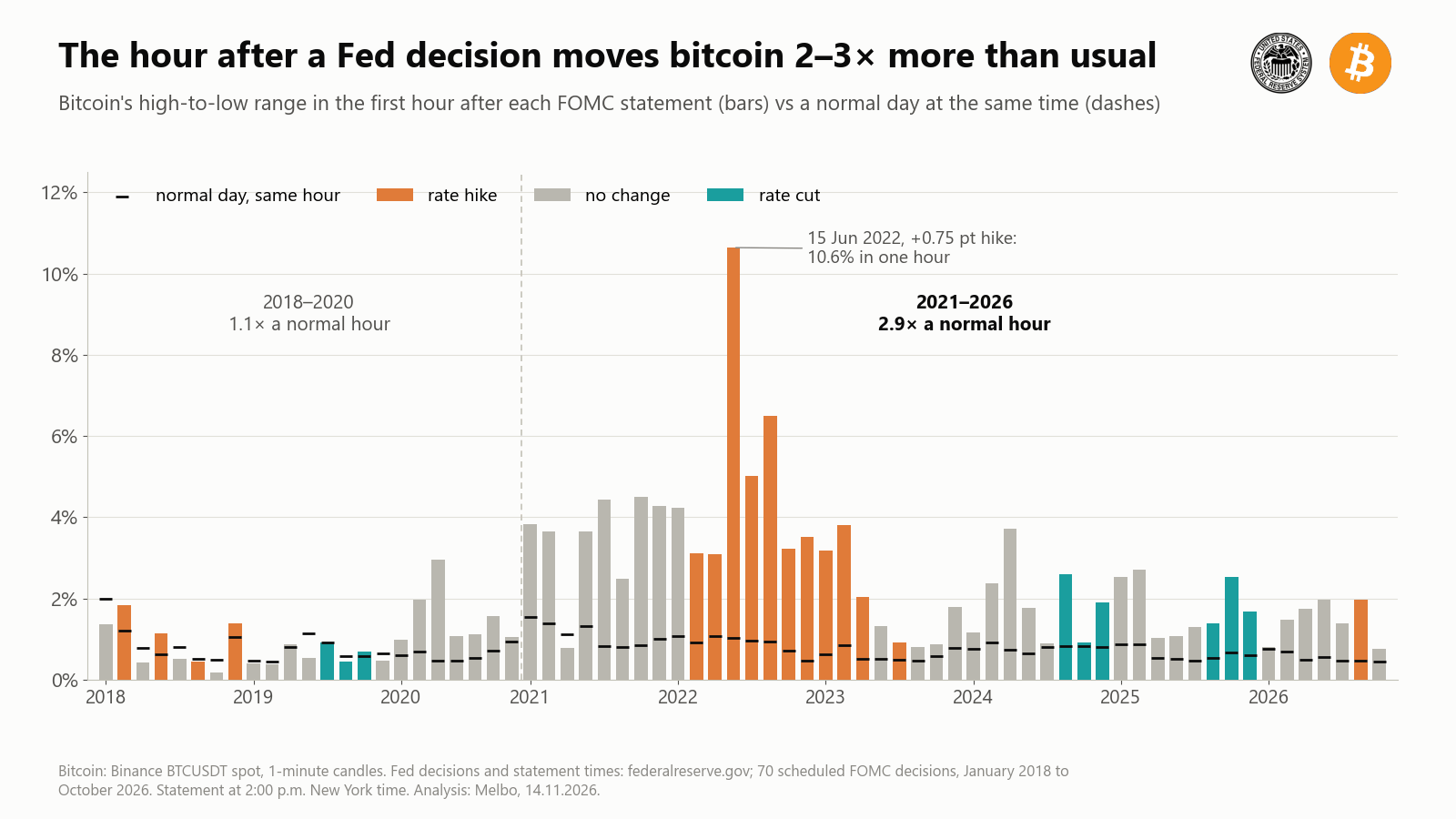
With a burst of movement, not a set direction. In the first hour after the 2:00 p.m. statement, bitcoin's median high-to-low range was 1.52%. On normal weekdays in the same hour, within 30 days of each meeting, it was 0.72%. The range was wider than normal after 58 of 70 decisions and at least twice as wide after 42.
The effect appeared only around 2021:
- 2018–2020: the first-hour range was 1.1 times a normal hour. Bitcoin barely noticed the Fed.
- 2021–2026: 2.9 times a normal hour, wider than normal after 46 of 47 decisions and at least double after 37.
Academic work finds the same turning point. A Bundesbank study, later published in the Journal of International Money and Finance, found bitcoin did not respond to US monetary policy announcements before late 2020 (Karau, 2023). A 2026 study of 41 Fed statements from 2021 to 2026 found bitcoin's average first-hour move almost doubled, from 0.66% to 1.25% (Yang and Wang, Finance Research Letters). Our minute data show the same picture across more meetings.
Does bitcoin go up or down after a Fed decision?
Not in a predictable direction. Bitcoin rose in the first hour after 38 of 70 decisions and fell after 32. The median move was +0.04%. Over the next 24 hours it rose after 34 decisions and fell after 36.
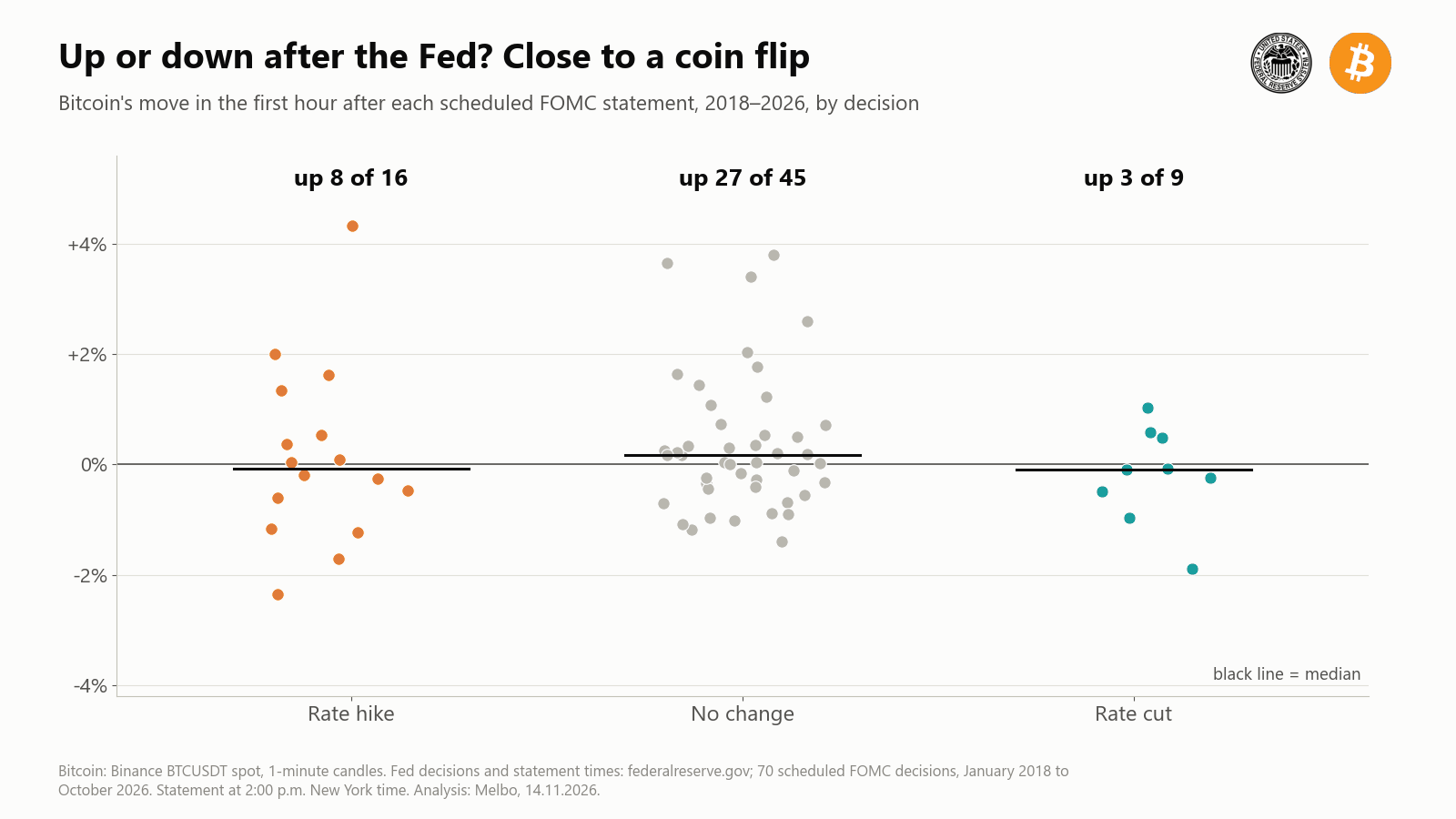
- Rate hikes: up 8 times out of 16. A hike is usually expected weeks in advance, so the decision itself rarely surprises.
- Rate cuts: up only 3 times out of 9. The worst was December 18, 2024: the Fed cut, but signalled fewer cuts ahead, and bitcoin fell 1.9% in the hour and 5.6% in a day.
- Meetings with projections: at the 34 meetings with a dot plot, like December 9, bitcoin rose in the first hour 15 times and the median move was −0.15%. The swings were also larger: 2.6 times a normal hour, against 2.1 at other meetings.
Studies on hourly and daily data found the same: volatility rises around Fed decisions, while the average return stays close to zero (Volmex Labs, 2024). Economists at the New York Fed found no reaction of bitcoin to surprise rate changes in 2017–2022 (Staff Report 1052).
Statement or press conference: when does bitcoin move?
In both half hours. We split each meeting into two equal windows: 2:00 to 2:30 p.m., right after the statement, and 2:30 to 3:00 p.m., when the press conference begins. Across 66 meetings with a press conference, the median high-to-low range was 1.12% in the first half hour and 1.15% in the second, each about 2.3 times the same half hour on a normal day. In 46% of meetings, the second half hour went the opposite way to the first.
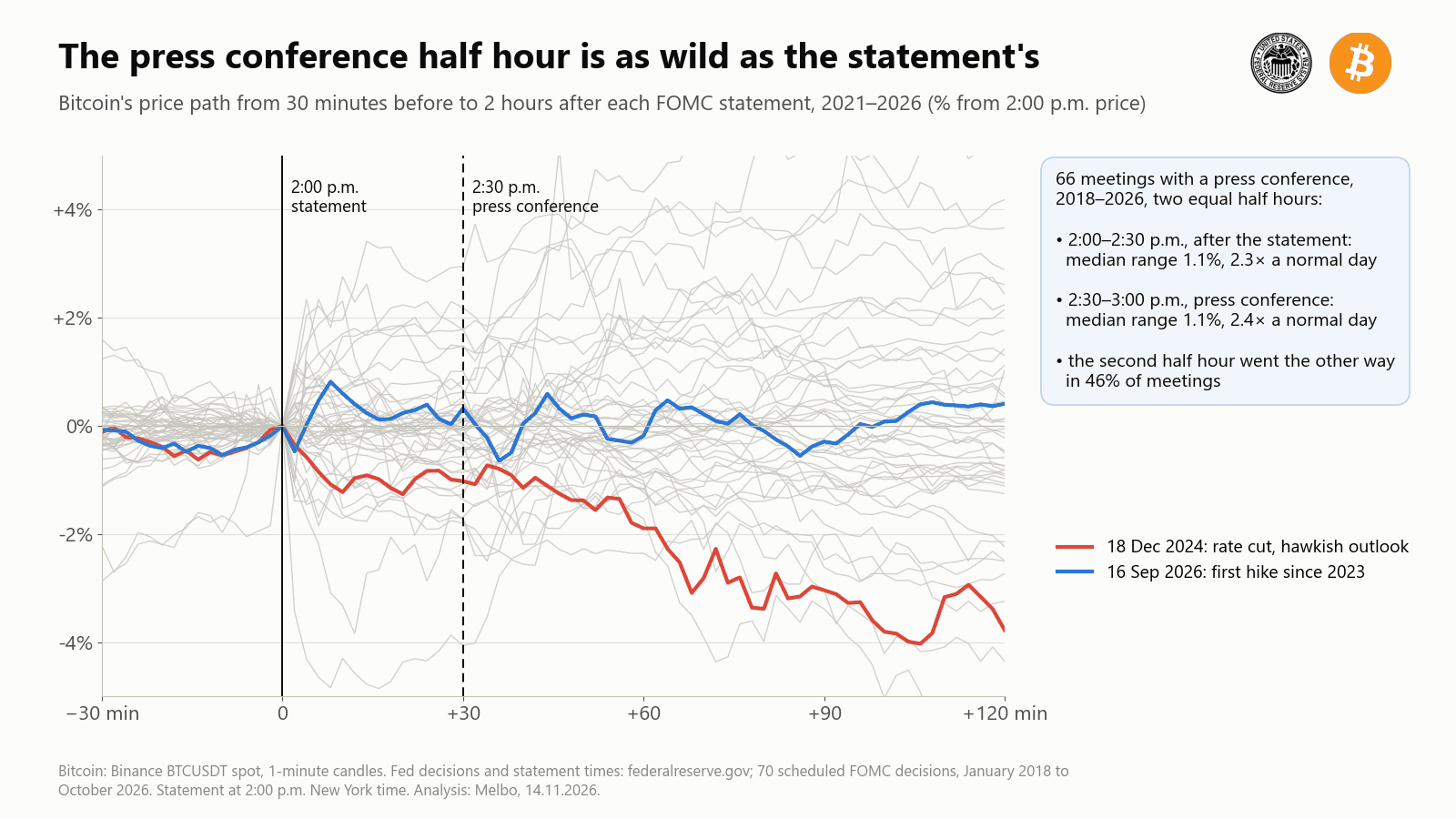
So the first reaction to the statement is not the market's last word. The press conference brings as much movement again, in either direction:
- December 18, 2024: bitcoin fell 1.0% in the first 30 minutes after the cut, then another 2.0% over the next hour, during and after the press conference.
- September 16, 2026, Warsh's first hike: bitcoin rose 0.3% after the statement, then fell 0.6% over the next hour. A day later it was 1.2% higher.
Under Warsh the press conference is shorter, about 30 minutes, so it now fits almost exactly into the 2:30 to 3:00 p.m. window.
What did bitcoin do after past December Fed meetings?
There have been eight December decisions since 2018. Bitcoin rose in the first hour after five and fell after three. The three falls came after the two hikes (2018 and 2022) and the 2024 cut with its hawkish projections.
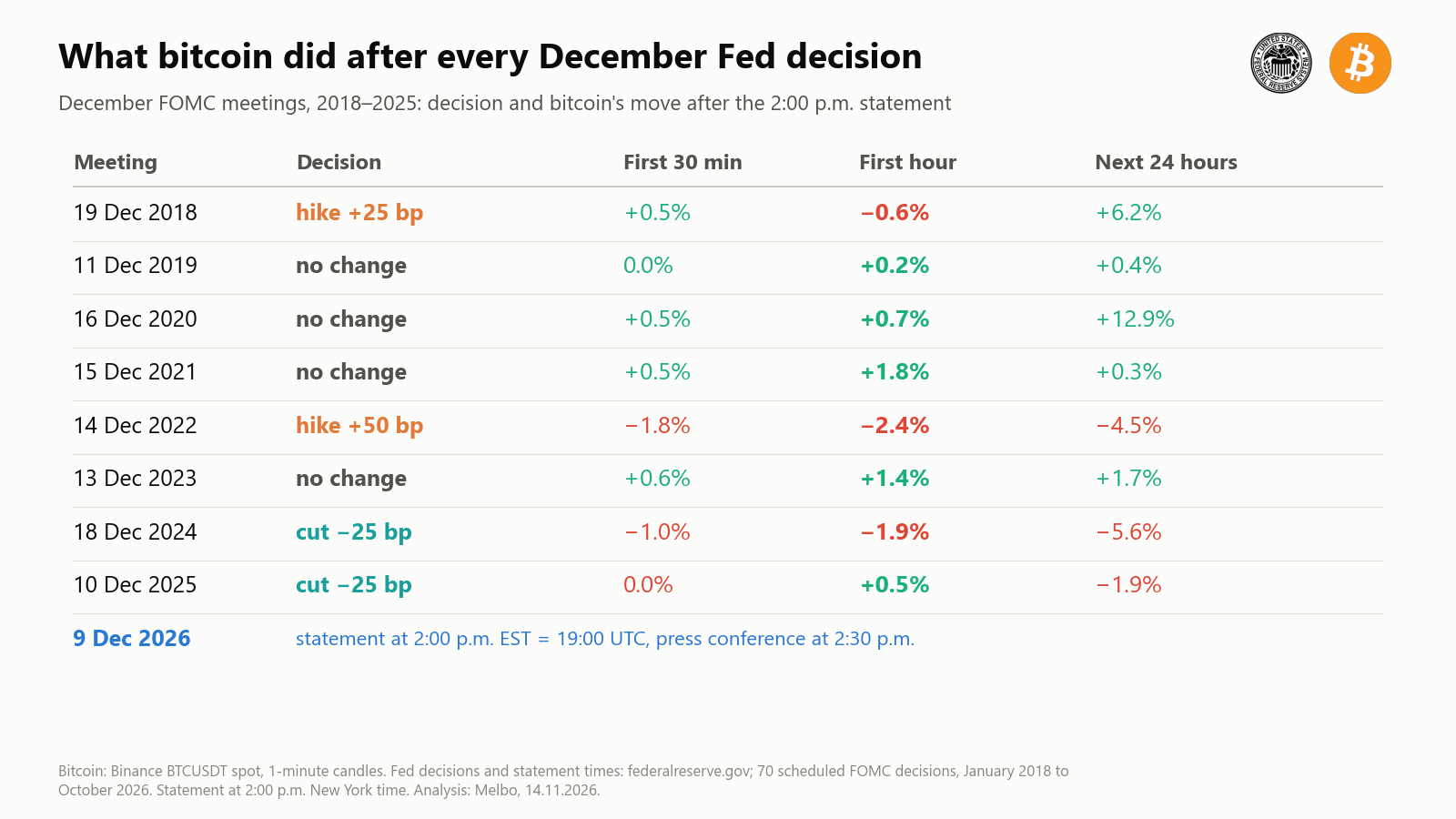
- December 14, 2022, hike of 0.5 points: −1.8% in 30 minutes, −2.4% in the hour, −4.5% in a day.
- December 16, 2020, no change: +0.7% in the hour and +12.9% in a day, during the bull run of late 2020.
- December 10, 2025, the most recent: a cut of 0.25 points with three dissents. Bitcoin was flat after the statement, rose 1.2% during the press conference and was 1.9% lower a day later.
Eight meetings is a small sample, and each came in a different market. Use them as examples of what can happen, not as a pattern.
What happens to bitcoin when the Fed raises rates?
The swings get bigger. After 16 rate hikes, the median first-hour range was 3.1%, about four times a normal hour. The direction was still split evenly: up 8 times, down 8 times.
- The largest swing in our data came on June 15, 2022, after a 0.75-point hike: 10.6% from high to low within one hour.
- The other 0.75-point hikes of 2022 brought ranges of 5.0% (July), 6.5% (September) and 3.2% (November).
- The only hike of the Warsh era so far, on September 16, 2026, brought a range of 2.0%, about four times normal for that hour, and a move of −0.2% over the hour.
Bitcoin was more volatile in 2022 in general, so part of those swings reflects the market of the time. The comparison with a normal hour, which we make for each meeting separately, takes some of that into account.
Unscheduled decisions can be bigger still. On Sunday, March 15, 2020, the Fed cut rates by a full point at 5:00 p.m. New York time. Bitcoin rose 13.9% within an hour and was 5.6% lower a day later. Twelve days earlier, on March 3, an emergency cut of half a point at 10:00 a.m. brought a range of 2.4% in the hour.
What to watch on December 9
- Your local time. 2:00 p.m. EST is 19:00 UTC. Check what that is where you are.
- The statement and the dot plot at 2:00 p.m. The size of the rate change, how many officials voted against it, and where the dots for 2027 sit.
- The press conference at 2:30 p.m. In our data the half hour after it was as volatile as the half hour after the statement, and often went the other way.
- The next morning. November consumer prices come out on December 10, so the Fed hour may not be the last big move of the week.
How can you use this on Melbo?
Melbo lists markets on the economy, including Fed decisions, and on crypto. A price in a market reads as a probability: 70¢ means the market sees about a 70% chance. The numbers above give you base rates to compare against. Since 2021, bitcoin's range in the hour after the statement was wider than on a normal day after 46 of 47 decisions, with a median of 2.0%. The direction, on the other hand, has been close to 50/50. A price that ignores either of these deserves a second look. If prediction markets are new to you, start with how prediction markets work.
Frequently asked questions
When is the next Fed meeting?
The next FOMC meeting is on December 8–9, 2026. The decision is published on Wednesday, December 9, at 2:00 p.m. EST (19:00 UTC), and the chair's press conference starts at 2:30 p.m. EST. The minutes come out on December 30.
What time is the Fed announcement on December 9, 2026?
The policy statement is released at 2:00 p.m. Eastern Time, which in December is EST, or 19:00 UTC. The press conference with Chair Kevin Warsh begins at 2:30 p.m. EST (19:30 UTC). In summer the same 2:00 p.m. is 18:00 UTC.
Will the Fed raise rates in December 2026?
Markets expect it. On November 10, CME FedWatch put the probability of a 0.25-point hike at 88.8% and of a 0.50-point hike at 11.2%, after October inflation came in at 0.4% a month. In September, 16 of 18 Fed officials projected at least one more hike in 2026. The decision is made by vote on December 9.
Does bitcoin go up when the Fed cuts rates?
Not reliably. After 9 scheduled rate cuts from 2018 to 2026, bitcoin rose in the first hour 3 times. What matters more is what the Fed signals about the future: in December 2024 the Fed cut but projected fewer cuts, and bitcoin fell 5.6% in a day.
Does bitcoin fall when the Fed raises rates?
Not reliably either. After 16 rate hikes, bitcoin rose in the first hour 8 times and fell 8 times. Hikes did bring larger swings: the median range in the first hour was 3.1%, about four times a normal hour.
What is the Fed dot plot?
The dot plot is a chart in the Fed's Summary of Economic Projections, published four times a year. Each dot is one official's view of where the policy rate should be at the end of each year. In September 2026 the median dot for the end of 2026 was 4.1%. Chair Warsh does not submit a dot, so there are 18 instead of 19 (September projections).
Who is the Fed chair in 2026?
Kevin Warsh has chaired the Federal Reserve since May 22, 2026. Jerome Powell, chair from February 2018, remains a member of the Board of Governors. December 9 will be Warsh's fifth meeting as chair.
How we measured
We took one-minute BTCUSDT prices from Binance's public data archive for every scheduled FOMC decision from January 31, 2018 to October 28, 2026: 70 decisions, plus the two emergency cuts of March 2020, which we show separately. The start of each window is the exact time of the policy statement from the Fed's press release, converted to UTC with daylight saving time. "First hour" is 2:00 to 3:00 p.m. New York time; the range is the highest minus the lowest price in that hour, divided by the price at 2:00 p.m. "Normal" is the median of the same hour on weekdays within 30 days of each meeting, excluding other Fed days. We checked every decision against the Fed's target rate history on FRED. Bitcoin trades on many exchanges, so other venues may show slightly different numbers. In 2018 the Fed held press conferences only at four meetings a year; the comparison of statement and press conference uses the 66 meetings that had one.
What to do next
Mark December 9, 2:00 p.m. EST, in your own time zone, and keep 2:30 p.m. in mind as well: the half hour of the press conference has been as volatile as the half hour after the statement.