How Often Does the Favourite Win a CS2 Major? We Checked All 464 Matches Before Singapore
We matched every CS2 Major result against Valve's world ranking. The favourite wins about three matches in five, best-of-ones between close teams are a coin flip, and every champion so far came from the top 6.
The higher-ranked team won 288 of the 464 matches played at the five CS2 Majors, or 62%. That is our count of every match from Copenhagen 2024 to Cologne 2026, with "favourite" meaning the team placed higher in Valve's world ranking before the event. The format changes the picture: the favourite won 59% of best-of-one matches and 66% of best-of-three and best-of-five series. Between teams fewer than 16 places apart, a best-of-one was close to a coin flip. Every Major champion so far was ranked in the top 6 before the event, but the top-ranked team won only once in five tries.
The next test is the PGL Major Singapore 2026, which starts on November 24 and ends with the grand final on December 13.
How often does the favourite win a CS2 Major match?
About three times in five. Across all five Majors, the team ranked higher in the Valve Regional Standings (VRS) beforehand won 62.1% of matches. The result was steady from event to event: between 60.4% in Austin 2025 and 64.4% in Shanghai 2024.
How far apart the teams are matters more than anything else:
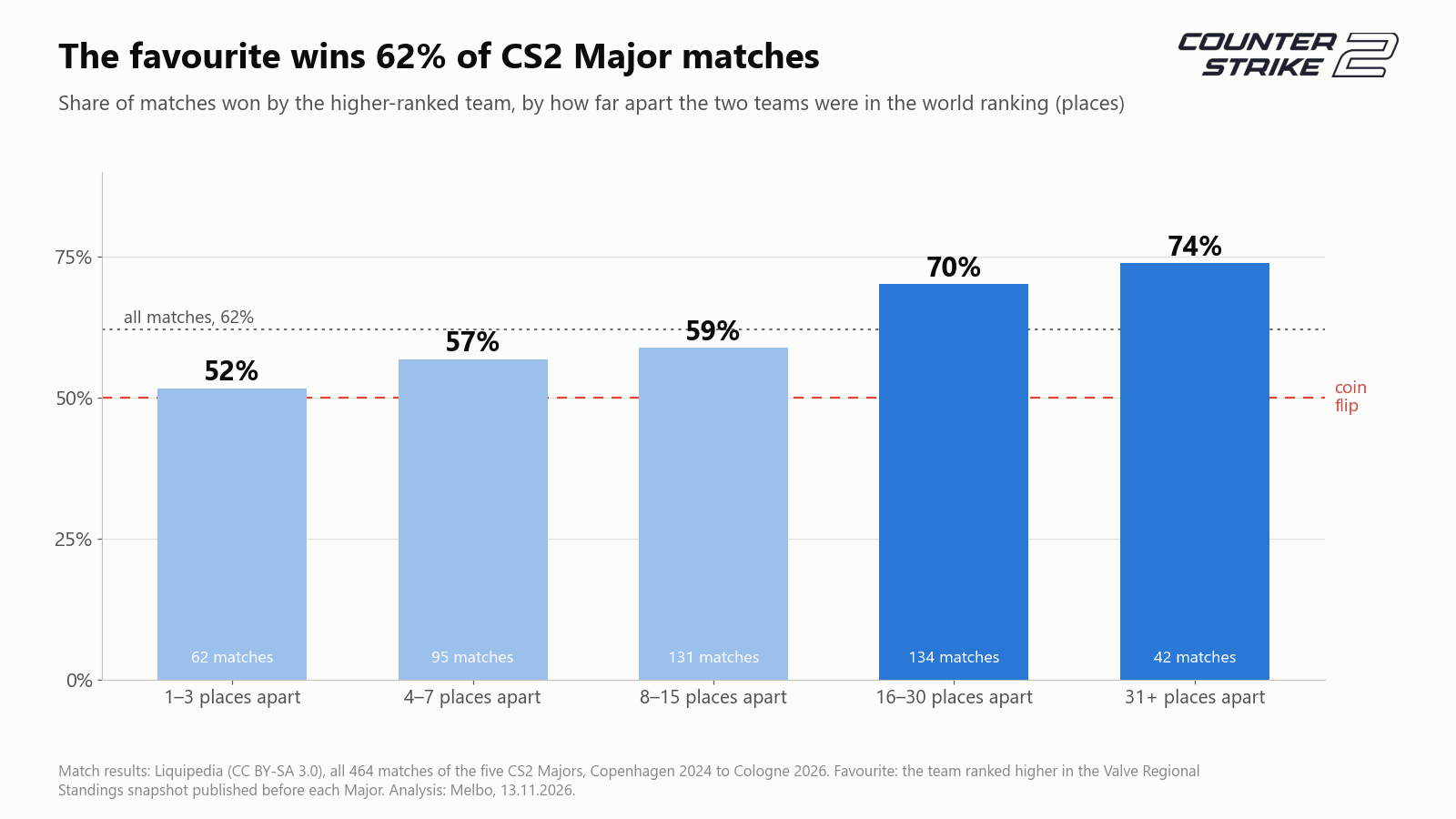
- Neighbours in the ranking are close to 50/50. Teams 1–3 places apart: the favourite won 52% of 62 matches.
- The edge appears at about 16 places. At 16–30 places apart the favourite won 70%, at 31 or more 74%.
- Points tell the same story. The VRS gives each team a score. When two teams were fewer than 100 points apart, the favourite won 51% of 102 matches. At 300 points or more it won 70% of 170.
- Even a big favourite loses about one match in four. A top-5 team facing a team outside the top 20 won 24 of 30 such matches, or 80%.
Is a best-of-one more random than a best-of-three?
Yes, and by a lot. Most early-stage matches at a Major are played as a single map (Bo1); elimination and advancement matches, the playoffs and the final are series (Bo3, and since Budapest 2025 a best-of-five final).
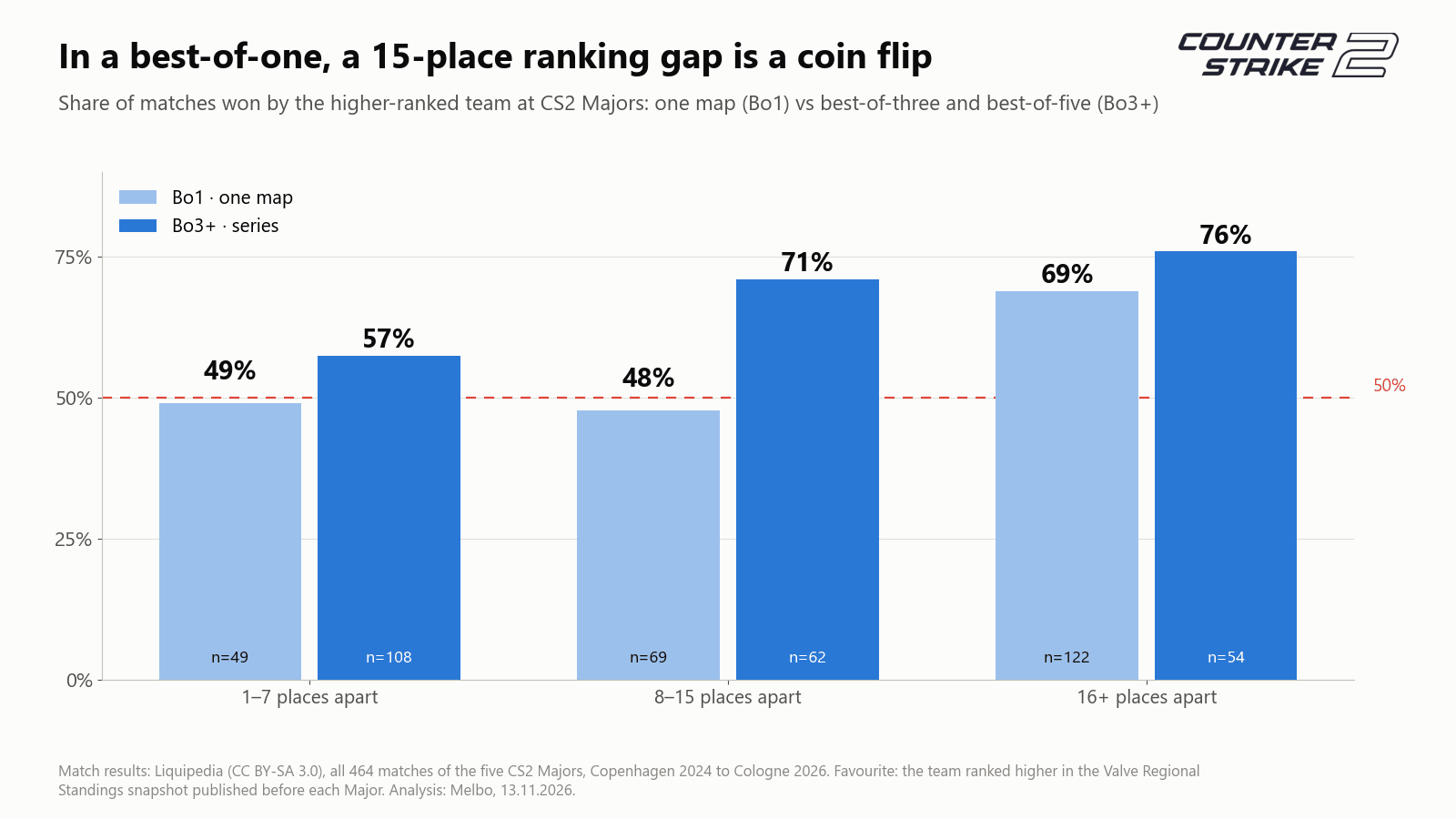
With teams 8–15 places apart, the favourite won 48% of 69 best-of-ones and 71% of 62 series. In a single map, one strong half or one pistol round can decide the result; over three maps, the better team has more room to recover. Only when the gap reached 16 places or more did the favourite win most best-of-ones (69% of 122).
Does the top-ranked team win the Major?
Rarely. The team ranked No. 1 before the event won one of the five CS2 Majors: Vitality in Austin 2025. The champion, though, always came from near the top.
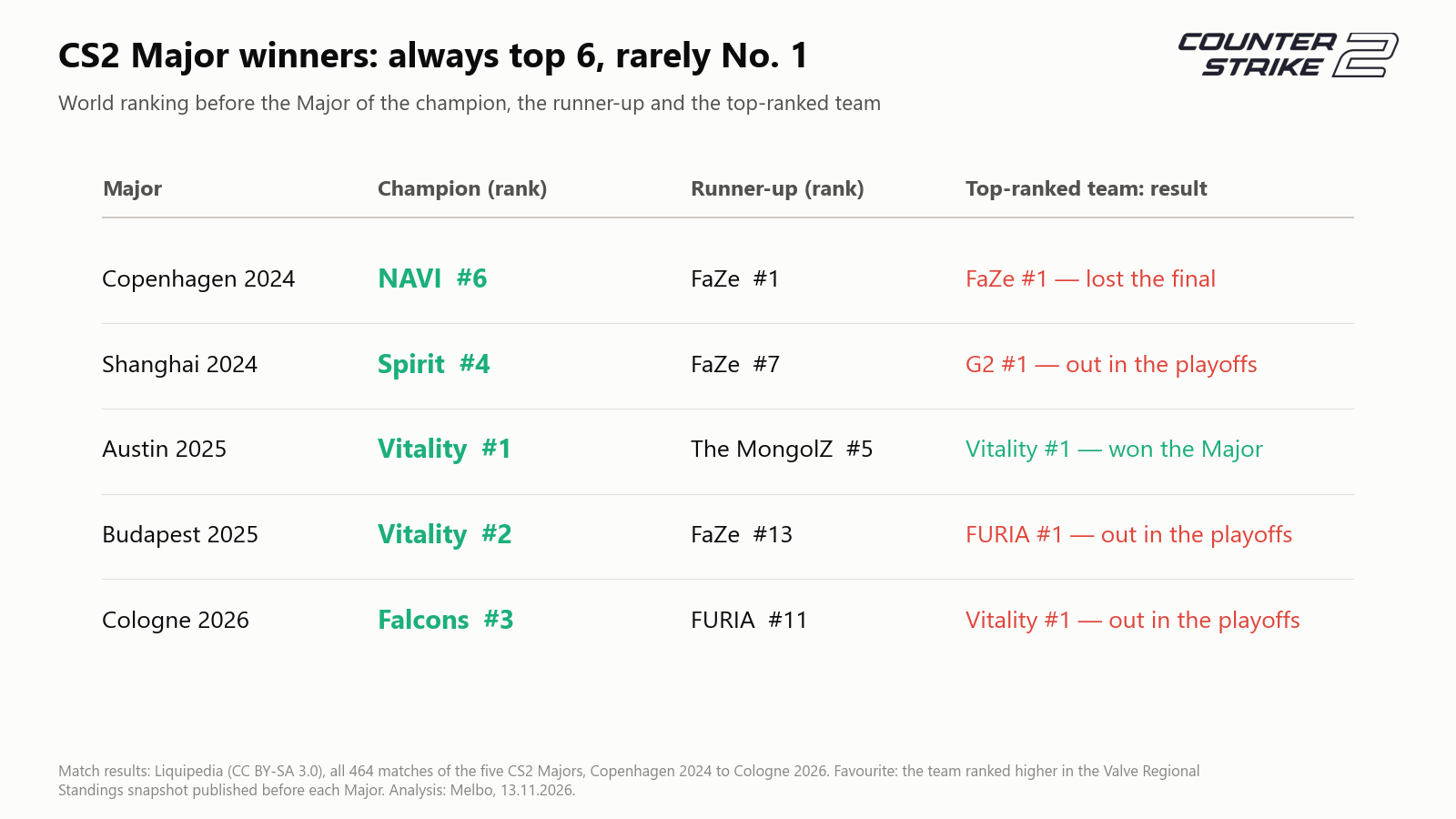
- Copenhagen 2024: NAVI, ranked 6th, beat the top-ranked FaZe 2–1 in the final.
- Shanghai 2024: Spirit (#4) beat FaZe (#7); the top-ranked G2 went out in the playoffs.
- Austin 2025: Vitality, ranked 1st, won the title 2–1 against The MongolZ (#5).
- Budapest 2025: Vitality (#2) beat FaZe (#13) 3–1 in the first best-of-five final; top-ranked FURIA went out in the playoffs.
- Cologne 2026: Falcons (#3) beat FURIA (#11) 3–0, the first Major for the organisation and for NiKo. Top-ranked Vitality went out in the playoffs.
The higher-ranked team won four of the five finals. The playoffs as a whole were no more predictable than the group stages: the favourite won 63% of the 35 playoff matches and 62% of the 429 matches before them.
What were the biggest upsets at CS2 Majors?
Measured by the gap in the ranking, these are the five largest:
| Major and stage | Winner (rank) | Beat (rank) | Format |
|---|---|---|---|
| Shanghai 2024, Opening Stage | Rare Atom (#89) | fnatic (#22) | Bo3, 2–1 |
| Cologne 2026, Stage 1 | FlyQuest (#83) | SINNERS (#34) | Bo1 |
| Austin 2025, Stage 3 | Legacy (#49) | Vitality (#1) | Bo1 |
| Cologne 2026, Stage 1 | THUNDER dOWNUNDER (#64) | MIBR (#20) | Bo1 |
| Austin 2025, Stage 2 | Legacy (#49) | FaZe (#10) | Bo3, 2–0 |
Two of these teams lost to an underdog and still went deep. Vitality lost to Legacy on June 12, 2025 and lifted the Austin trophy ten days later. In Budapest 2025, FaZe lost its Stage 1 best-of-one to NRG (#49) and then reached the grand final. Upsets of 20 places or more ranged from 4 per Major (Shanghai 2024, Cologne 2026) to 13 (Austin 2025). Austin's Brazilian side Legacy accounted for four of them on its own.
What does this mean for the Singapore Major?
The PGL Major Singapore 2026 is the first Counter-Strike Major in Southeast Asia. All 32 teams were invited by the VRS snapshot of November 2, 2026: 16 start in Stage 1, 8 in Stage 2 and the top 8 in Stage 3 (Liquipedia). Stages 1 and 2 use best-of-ones with best-of-three deciders, Stage 3 is all best-of-three, the playoffs are best-of-three and the grand final is best-of-five. A third-place decider is played for the first time (Strafe).
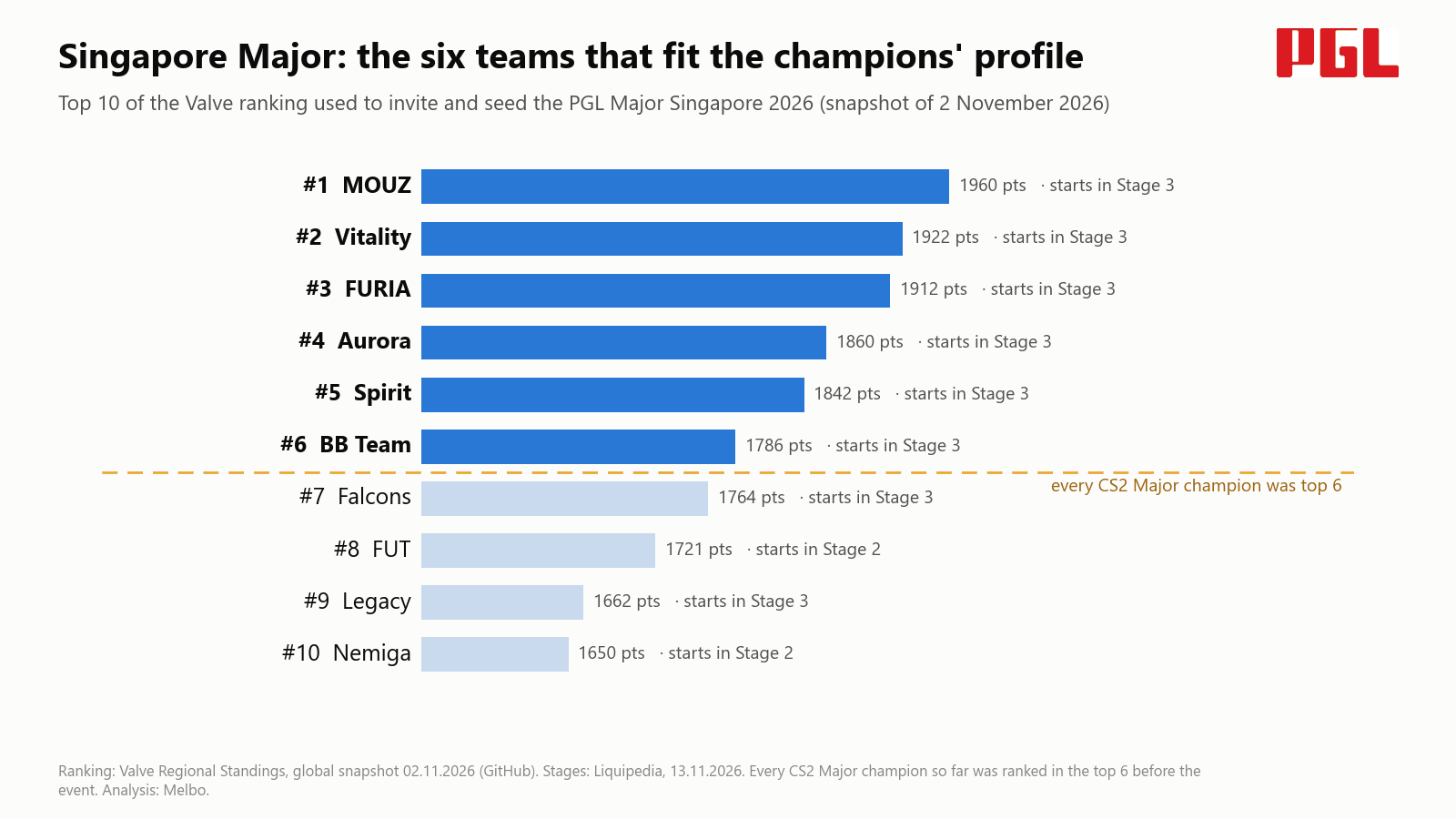
Six teams fit the profile of every CS2 Major champion so far, a top-6 ranking: MOUZ, Vitality, FURIA, Aurora, Spirit and BB Team. The gaps at the very top are small. MOUZ leads Vitality by 38 points and FURIA by 48, well inside the range where the favourite won only half of the matches. Four of the teams in Singapore play under different names because of Singapore's advertising rules, so the ranking may list them differently (Liquipedia).
From five Majors, four rules of thumb:
- A best-of-one between teams within about 15 places is close to 50/50. In our data it was 49% at 1–7 places and 48% at 8–15.
- A gap of 16 places or more gives the favourite about 70%. Even then it loses roughly one match in four.
- Series favour the stronger team. Stage 3, the playoffs and the final are all series, so the ranking matters more there than in Stages 1 and 2.
- The title has gone to a top-6 team every time, but to No. 1 only once. Five events is a small sample, so treat this as a pattern, not a law.
How can you use this on Melbo?
Melbo lists esports markets, including Counter-Strike matches. The price of an outcome reads as a probability: 70¢ means the market sees roughly a 70% chance. The numbers above give you a base rate to compare against. If a market prices a best-of-one favourite at 80¢ against a team ten places below, our data says such favourites won about half the time at Majors. The market may know something the ranking does not, such as a roster change, an illness or map pool, so use the base rate as a starting point, not a verdict. If prediction markets are new to you, start with how prediction markets work.
Frequently asked questions
How often does the favourite win in CS2?
At the five CS2 Majors, the team ranked higher in the Valve Regional Standings before the event won 62.1% of matches (288 of 464). In best-of-one matches the figure was 58.8%, in best-of-three and best-of-five series 65.6%.
Which ranking decides who goes to a CS2 Major?
The Valve Regional Standings (VRS). Since the Budapest Major in 2025, all 32 teams are invited by the VRS and placed into Stage 1, 2 or 3 by their ranking (StarLadder). Valve publishes the standings on GitHub.
Who has won the CS2 Majors?
NAVI (Copenhagen 2024), Team Spirit (Shanghai 2024), Team Vitality (Austin 2025 and Budapest 2025) and Team Falcons (Cologne 2026).
When is the PGL Major Singapore 2026?
Stage 1 starts on November 24, 2026, according to Liquipedia; some announcements give November 25. The playoffs run from December 10 to 13 at the Singapore Indoor Stadium, with a best-of-five grand final.
Is the number one team likely to win the Singapore Major?
History says it is the single most likely winner but far from a sure thing. In five CS2 Majors the top-ranked team won once; every champion was ranked in the top 6.
What is the biggest upset in CS2 Major history?
By ranking gap, Rare Atom, ranked 89th, beating fnatic, ranked 22nd, 2–1 in the Opening Stage of Shanghai 2024. The most famous is Legacy (#49) beating Vitality (#1) in Austin 2025, ten days before Vitality won the title.
How we counted
We took the results of all 464 matches of the five CS2 Majors from Liquipedia's stage pages (text available under CC BY-SA 3.0), excluding one show match in Copenhagen. For each Major we used the global VRS snapshot published before the event started: November 25, 2024 for Shanghai, June 2, 2025 for Austin, November 3, 2025 for Budapest and June 1, 2026 for Cologne. Valve did not publish a global table before Copenhagen 2024, so we merged the European, American and Asian standings of March 4, 2024 by points. When an organisation had more than one roster in the standings, we used its best-ranked roster. The two best-of-five finals are counted with best-of-three series. A different snapshot or rule can move individual percentages by a point or two; the patterns hold.
What to do next
Note three dates: Stage 1 on November 24, Stage 3 from December 2 and the grand final on December 13. Check how far apart two teams are in the ranking and whether the match is a single map or a series before you form a view.