Prediction Market Insider Trading in 2026: Every Documented Case on Polymarket and Kalshi
A sourced list of every insider trading and manipulation case on prediction markets in 2025–2026: who was charged, who settled, what is only alleged, and what the price did before the news.
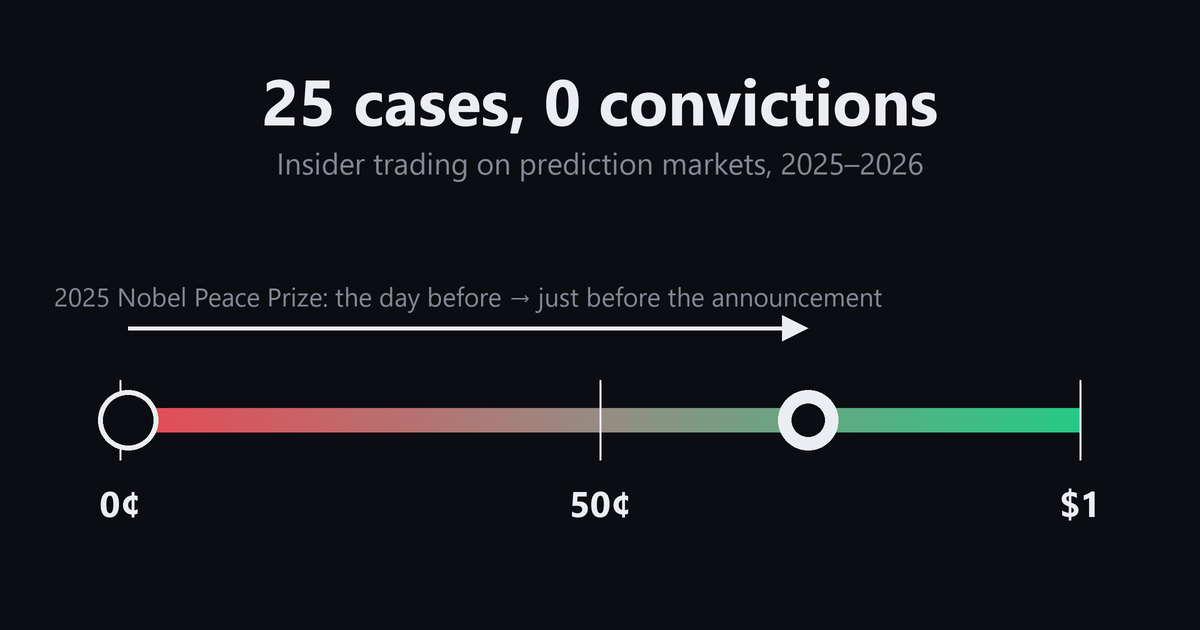
As of 26 October 2026 we count 25 documented cases of insider trading or manipulation on prediction markets in 2025–2026. Six are actions by authorities: four CFTC cases in the US and two criminal cases in Israel. Six are penalties imposed by an exchange or an employer, and 13 are investigations or allegations with no charges. Nobody has been convicted yet. The first US jury trial, of the soldier who traded on the Maduro operation, is tentatively set for 7 December 2026.
Each case below has a date, platform, amount, status and a link to the primary document where one exists. We also checked the price history of 29 markets. Flagged markets moved more before the news than comparable ones, but the gap was not statistically reliable, and the two US criminal cases barely showed in the final day's price. Charges are allegations until a court decides, and a suspicious trade is not proof of a crime. This is a reference compiled from public sources, not legal advice.
Is insider trading illegal on prediction markets?
In the US, yes, when it fits existing commodities law. The CFTC treats trading on confidential information taken in breach of a duty (to an employer, a client or the government) as fraud under Section 6(c)(1) of the Commodity Exchange Act and CFTC Rule 180.1. Its Enforcement Division said on 25 February 2026 that this applies to event contracts on any regulated exchange (CFTC advisory).
Two more rules matter. The "Eddie Murphy rule" in Section 4c(a)(4) bars government employees from trading on non-public government information and bars anyone they tip. The CFTC used it for the first time in the Maduro case. And a person who controls the outcome and misleads the market can be charged with manipulation, which is how the CFTC handled former congressman George Santos (CFTC).
Kalshi and Polymarket also ban it in their own rules, so a trader can lose an account and pay a penalty even when no regulator acts. Outside the US, local criminal law applies: Israel charged its cases as leaking secrets, espionage and bribery.
Informed trading is not automatically illegal. Your own research, a model built on public data or a poll you ran yourself are allowed under both platforms' rules (Polymarket market integrity). The line is information you got through a duty to keep it private, or the power to decide the result.
Every documented case: the 2026 list
We split the list into three groups, because "insider trading" in the news covers very different things: criminal charges, a $2,000 exchange fine and an anonymous wallet that bought before a strike.
Actions by authorities (6)
| Date | Platform | Who and what | Amount | Status |
|---|---|---|---|---|
| 12 Feb 2026 | Polymarket | Israeli Air Force reserve major and a civilian friend: timing of Israel's strike on Iran, June 2025 | $162,663 profit | Indicted in Tel Aviv District Court, pending |
| 23 Apr 2026 | Polymarket | US Army master sergeant Gannon Ken Van Dyke: "Maduro Out by January 31, 2026?" | over $404,000 profit | Charged by CFTC and DOJ (SDNY), pleaded not guilty, trial set for 7 Dec 2026 |
| 27 May 2026 | Polymarket | Google engineer Michele Spagnuolo: Google Year in Search 2025 contracts | about $1.2M profit | Charged by CFTC and DOJ (SDNY), pending |
| 31 Jul 2026 | Kalshi | Former congressman George Santos: "Who will attend the State of the Union?" | $35,070 paid | Settled with CFTC (manipulation), 3-year ban |
| 16 Aug 2026 | Polymarket | A second Israeli Air Force major: strikes in Iran and Yemen | not disclosed | Pre-indictment hearing |
| 28 Aug 2026 | Kalshi | White House teleprompter operator Gabriel Perez: presidential mention markets | $172,539 paid | Settled with CFTC, 3-year ban |
Sources: CFTC releases 9217-26, 9237-26, 9276-26, 9289-26; NPR via WLRN, JFeed, The Yeshiva World citing N12.
Penalties by exchanges and employers (6)
| Date | Platform | Who and what | Amount | Status |
|---|---|---|---|---|
| 25 Feb 2026 | Kalshi | Kyle Langford, candidate for California governor: his own race (May 2025) | $2,246 penalty | 5-year suspension |
| 25 Feb 2026 | Kalshi | A video editor for MrBeast's channel: contracts on the channel's videos (Aug–Sep 2025) | $20,398 penalty | 2-year suspension, reported to CFTC |
| 27 Feb 2026 | Polymarket and others | An OpenAI employee: trades on prediction markets using confidential company information | not disclosed | Fired by OpenAI |
| 22 Apr 2026 | Kalshi | Three congressional candidates (Mark Moran, Ezekiel Enriquez, Matt Klein): their own races | penalties from $530 to over $6,200 | 5-year suspensions |
| 31 Aug 2026 | Kalshi | Three candidates (Stephen Cloobeck, Ben Midgley, Laurie Buckhout): their own races | up to $31,770 | 3-year suspensions |
| 15 Oct 2026 | Polymarket | Account pairs on the Ethiopia and Romania election markets: wash trading | over $600M of volume | Accounts blocked |
Sources: CFTC advisory 25 Feb, NPR, WIRED, AP via WTOP, ABC News, WIRED via DNYUZ.
Investigations and allegations without charges (13)
| Date | Platform | Market | What was reported | Status |
|---|---|---|---|---|
| 10 Oct 2025 | Polymarket | 2025 Nobel Peace Prize | María Corina Machado's price rose from about 4% to about 70% hours before the announcement; about $90K profit across three accounts | Internal review by the Nobel Institute, no result published |
| 15 Nov 2025 | Polymarket | "Will Russia capture Myrnohrad by November 15?" | An unauthorized edit to the ISW front-line map used for resolution showed a Russian advance that had not happened, timed with the market's close | Reported by 404 Media |
| 28 Feb 2026 | Polymarket | "US strikes Iran by February 28?" | Six wallets funded within a day bought Yes hours before the strikes; about $1M profit | Alleged by on-chain analysts |
| 1 Mar 2026 | Polymarket | Iran strike timing | One account opened its first position about 71 minutes before the strike was public; over $553,000 profit | Alleged |
| 16 Mar 2026 | Polymarket | Iranian missile strike contract | Traders pressured a journalist to rewrite a story the market relied on | Reported, not verified by us |
| 25 Mar 2026 | Polymarket | Taylor Swift engagement | Heavy buying before the announcement, flagged by an academic screen | Alleged |
| 8 Apr 2026 | Polymarket | US–Iran ceasefire | At least 50 new wallets and one cluster (over $600K) bought Yes before the ceasefire post | Rep. Torres asked the CFTC to investigate |
| 23 Apr 2026 | Polymarket | Paris daily high temperature | Suspected tampering with the airport weather sensor; $119 grew to $21,398 | Météo-France complaint to police |
| May 2026 | Polymarket, PredictIt | Election races | Campaign staff traded ahead of internal polls | Media report |
| 19 May 2026 | Polymarket | Dublin Central by-election | About $1M traded, much of it on one candidate not winning | Irish government review |
| 30 Jun 2026 | Polymarket | 5-minute Bitcoin up/down | Spot orders in the last seconds moved the settlement price; about $8.2M profit in flagged windows (press figure) | Academic paper, rule change |
| 2 Jul 2026 | Kalshi | Most-streamed Spotify song in June | Over 500,000 artificial streams pushed a song to No. 1 | Kalshi reportedly investigating |
| 9 Oct 2026 | Kalshi | "Will Graham Platner drop out?" | Correlated cheap buys the night before damaging news | Alleged by researchers |
Sources: The Block, 404 Media, Wikipedia, The Block, NPR via NHPR, Harvard Law School Forum, Decrypt, Rep. Torres, NPR via WAMC, NPR via VPM, RTÉ, arXiv, The Block, CNN.
On-chain analysts can see when a wallet was funded and what it bought, but not who controls it. Bubblemaps, which flagged the February Iran wallets, said it is almost impossible to be fully certain. Treat the third table as open questions.
The four US cases in detail
The soldier and the Maduro market
The CFTC says Gannon Ken Van Dyke, a US Army Special Forces master sergeant, opened a Polymarket account on 26 December 2025 and bought more than 436,000 Yes shares in "Maduro Out by January 31, 2026?" between 30 December and 2 January. He had information about Operation Absolute Resolve, which captured Nicolás Maduro on 3 January. About $33,000 turned into more than $404,000. He later asked Polymarket to delete the account (CFTC, NPR via WRVO).
The CFTC called it the first insider trading charge it has brought on event contracts. Van Dyke pleaded not guilty and moved to dismiss, arguing that Polymarket contracts are not swaps under the Commodity Exchange Act. The CFTC's civil case is paused until the criminal case ends, and the trial is tentatively set for 7 December 2026 (ABC News, Decrypt).
The Google engineer and Year in Search
Michele Spagnuolo, a Google software engineer living in Switzerland, traded at least 23 contracts on Google's Year in Search 2025 between October and December 2025 under the name "AlphaRaccoon". The CFTC says he used confidential internal search data and made about $1.2 million. Prosecutors in New York filed a criminal complaint, and Google put him on leave (CFTC, TechCrunch).
The teleprompter operator and mention markets
Mention markets ask whether a speaker will say a given word. Gabriel Perez ran the teleprompter at the White House and traded Kalshi's presidential mention contracts from December 2025 to February 2026 with access to the speech texts. He made more than $107,500 and settled with the CFTC: he returned $107,539 and paid a $65,000 penalty, reduced for cooperation. Kalshi's surveillance flagged him and referred the case (CFTC). On 22 September the CFTC staff warned that mention markets carry a higher risk of manipulation because the result turns on one person's conduct (CFTC).
George Santos and the State of the Union
Santos traded contracts on whether he would attend the 2026 State of the Union while posting misleading statements about his plans, which moved the price his way. The CFTC treated this as manipulation, not insider trading. He paid $35,070 without admitting or denying the findings and was barred from trading for three years; Kalshi later banned him for life (CFTC, The Block).
Did the price move before the news? Our check of 29 markets
If insiders trade before the public knows, the price should move before the news. To test this we took the nine events in our list where both the market and the moment the information first became public (T0) can be pinned down: 15 markets in total, 14 on Polymarket and one on Kalshi. We compared them with 14 markets on similar events where nobody alleged anything. These were scheduled reveals (other Nobel prizes, TIME Person of the Year, other Google Year in Search categories) and sudden events (strikes and ceasefires). We fixed the rule for picking these controls before downloading any prices.
For each market we measured how much of the remaining distance to $1 the eventual winner covered in the 24 hours before T0. If a contract went from 20¢ to 60¢ before the news, it covered half of its remaining path.
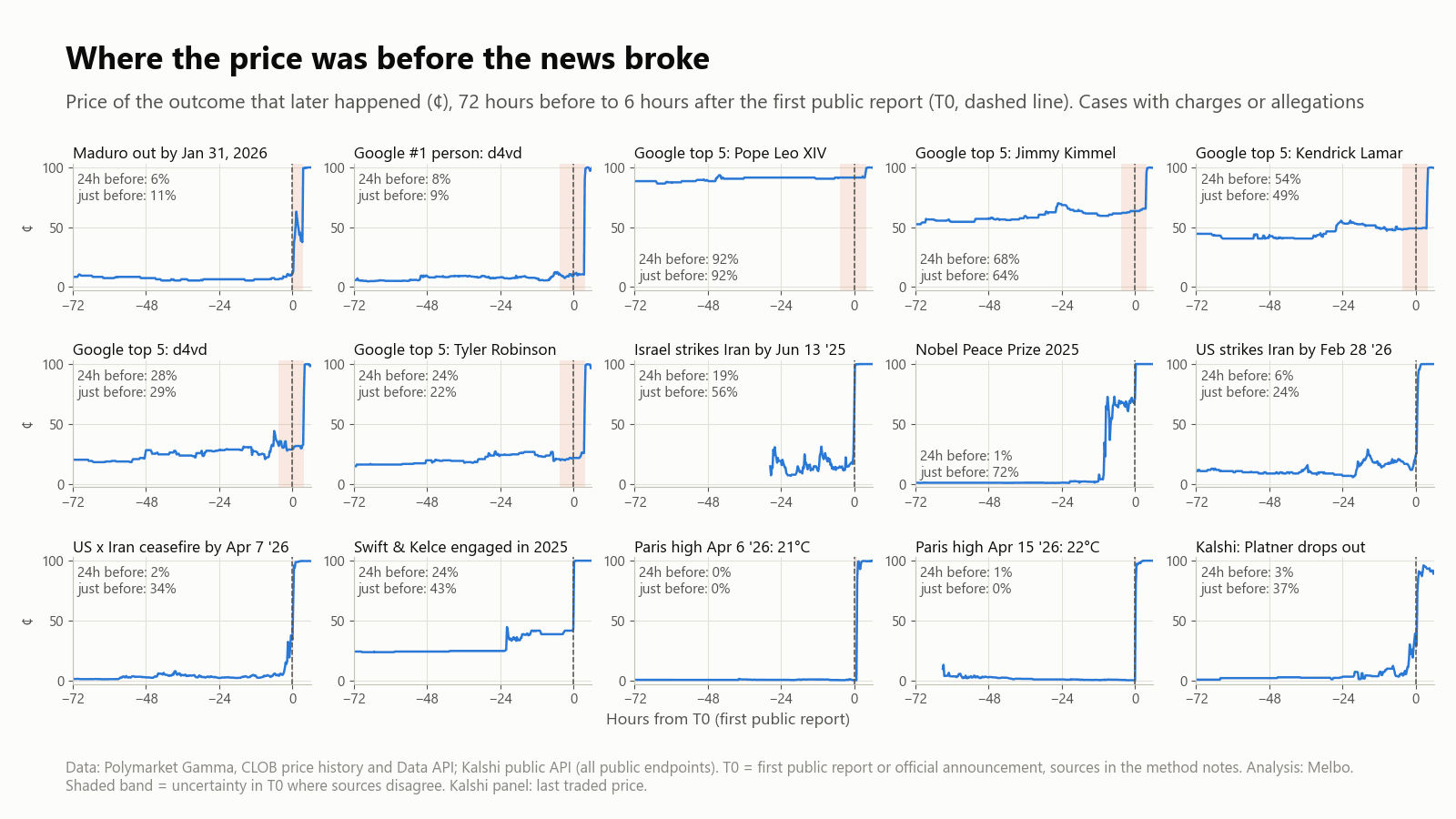
The 2025 Nobel Peace Prize stands out. María Corina Machado's contract traded at 0.85¢ a day before the announcement, 65.5¢ six hours before and 71.7¢ just before it, at 09:00 UTC on 10 October. That day the market traded about $976,000, against about $1,800 on a normal day. No scheduled-reveal control came close: their median was 5%, and the highest single contract reached 35%.
The two US criminal cases barely show in the final day. The Maduro contract moved from 6.5¢ to 11¢. The six Google Year in Search contracts in the two categories the CFTC named did not move on net (median −2%). Both traders built positions over days or weeks, so a screen that looks only for a last-minute jump would have missed them.
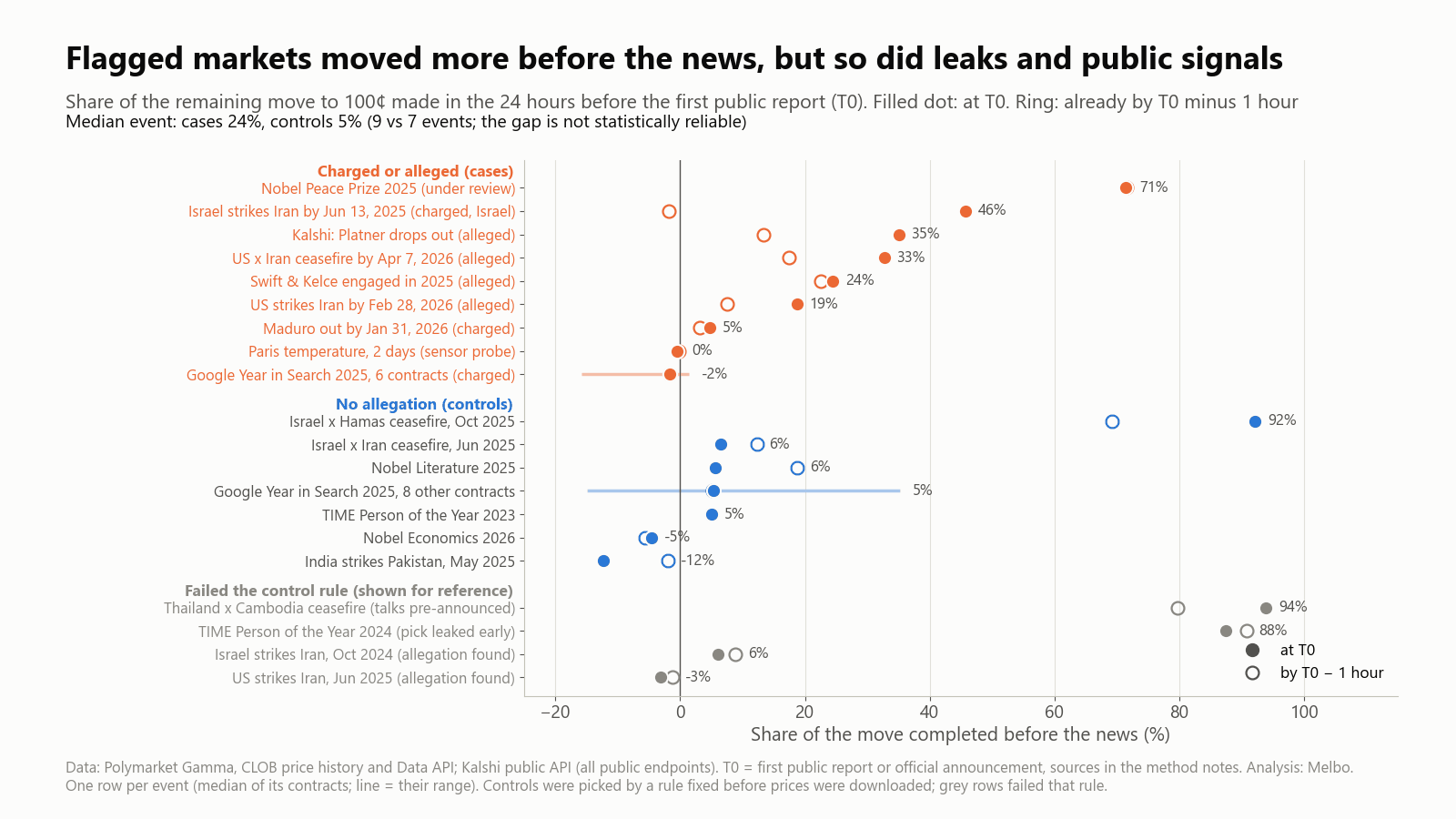
Across all events, flagged markets moved more, but not reliably more. The median event covered 24% of its remaining path before the news, against 5% for controls. With nine and seven events, that gap is not statistically reliable (one-sided Mann–Whitney test, p = 0.15).
Prices also move early with no insider at all. In the control group the Israel–Hamas ceasefire contract rose from 17¢ to 93.5¢ after Donald Trump said publicly that a deal was very close. The TIME 2024 pick, reported by Politico before the official reveal, went from 80¢ to 97.5¢. Public signals and media leaks look the same on a price chart as a leak from inside.
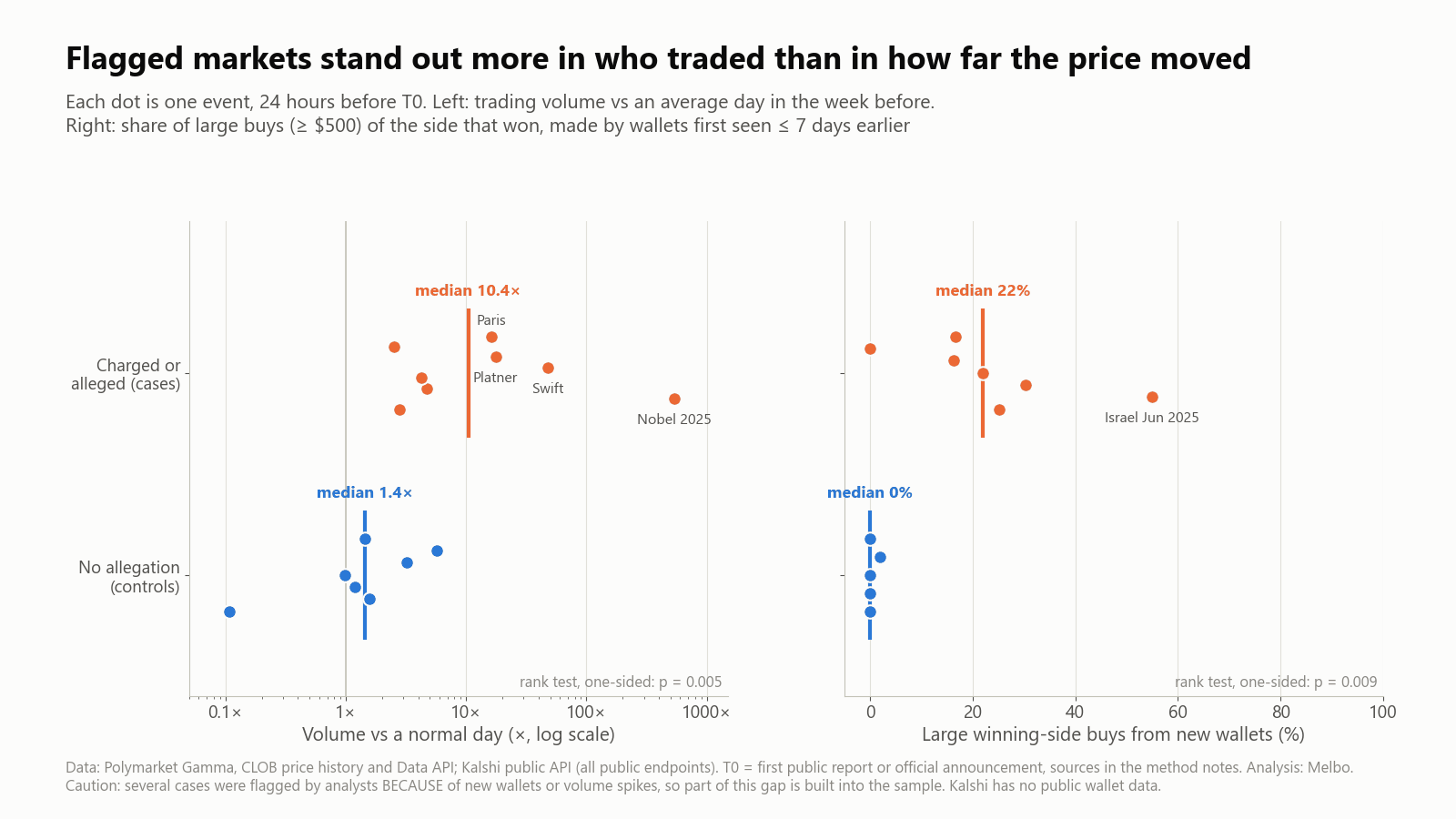
Who traded separates the groups better than the price. In the 24 hours before the news, flagged markets traded a median 10.4 times a normal day, against 1.4 times for controls (p = 0.005). About a fifth (22%) of large purchases of the winning side, $500 or more, came from wallets that first appeared on Polymarket within the previous week; in controls the median was zero (p = 0.009). Before Israel's strike on Iran in June 2025, 25 of 67 large buyers were new wallets.
This gap is partly built into the sample, because several cases were flagged precisely for fresh wallets or volume spikes. Big events also bring new users: before the 28 February strikes, 130 of 267 large buyers had first appeared that month.
Timing decides a lot. Markets react to the first reports within minutes. The Israel contract was still at 17.5¢ an hour before the first reports from Tehran, so the whole move came in the last hour. If T0 is set 11 minutes later, at the first Times of Israel entry, the share jumps from 46% to 99%. We used the earliest public report we could document for every market, which makes our numbers conservative.
What this means: a price jump before the news is a reason to look, not proof. Two of the clearest legal cases left almost no trace in the final day's price, and one of the biggest pre-news moves had nothing to do with insiders.
Insider trading or manipulation: what is the difference?
Insider trading is trading on information others don't have and you weren't entitled to use. Manipulation is changing the price or the result itself. In 2026 manipulation cases took four forms:
- Controlling the outcome. Candidates traded on their own races, and Santos on his own attendance.
- Tampering with the resolution source. A suspected weather sensor interference in Paris, artificial Spotify streams and an edited front-line map.
- Settlement price pressure. In 5-minute Bitcoin markets, one-sided spot orders in the last seconds moved the settlement price. Polymarket moved these markets to time-weighted average settlement on 7 August 2026 (Coinpaprika). Our analysis of 28,150 short BTC markets covers how they settle now.
- Wash trading. The "$600 million after the races ended" story from 15 October is about accounts trading with each other to inflate volume, not about insiders profiting.
For a trader the risk differs. Insider trading means someone on the other side knows more. Manipulation means the result or the settlement price may not reflect the real event.
How Kalshi and Polymarket police insider trading
| Kalshi | Polymarket (international) | Polymarket US | |
|---|---|---|---|
| Regulator | CFTC-regulated exchange (DCM) since 2020 | Offshore platform, not a CFTC-registered venue | CFTC-designated exchange, access through brokers since Nov 2025 |
| Identity checks | Full KYC before trading | No full KYC; trades are public on Polygon | Through the broker |
| Rules | Bans trading with material non-public information, by employees of the source agency and by anyone who can influence the outcome | Since 23 March 2026: bans stolen confidential information, illegal tips and influence over the outcome | Same rules in its rulebook |
| Prevention | Blocked lists of officials, campaign staff (matched with FEC data) and athletes (via IC360); job details for high-risk markets since June | Surveillance with Chainalysis and Palantir; a former FBI official leads investigations | Surveillance by the NFA |
| Reported numbers | Over 150 investigations, over 100 blocked cases and over 20 referrals in Q1 2026 | 315+ wallet details shared, 90+ referrals, 2 arrests (its site) | not published |
Sources: Kalshi insider trading rules, Kalshi blocked traders, Al Jazeera, Decrypt, Polymarket market integrity, Polymarket rules via Business Wire, PR Newswire, CNN.
Both systems have gaps. On Polymarket's international platform one person can open many wallets, which is why the Iran and ceasefire allegations involve "fresh" wallets. Kalshi checks identity, but its public archive of disciplinary decisions still says "coming soon" (Kalshi notices), so most cases become known through press releases and media.
Public trades cut both ways: anyone can screen Polymarket for suspicious timing, and most allegations in our list came from outside analysts. The US cases against Van Dyke and Spagnuolo concern trades on the international platform, because American users remain within reach of US authorities wherever they trade.
How much insider trading is there?
Nobody knows the true amount, but four studies give a range:
| Study | Data | Main finding |
|---|---|---|
| Mitts (Columbia) and Ofir (Haifa), March 2026 | Polymarket, Feb 2024–Feb 2026 | 210,718 suspicious wallet-market pairs with a 69.9% win rate and about $143M of "anomalous profit", called a lower bound |
| Gómez-Cram, Guo, Kung and Jensen, April 2026 | All Polymarket trades 2023–2025, 1.72M accounts | 3.14% of accounts are consistent winners; 1,950 accounts look like one-event insiders and move prices 7–12 times more per dollar |
| Bloomberg Businessweek with Polysights, July 2026 | About 34,000 flagged trades, Aug 2025–Jun 2026 | About $200M of suspicious volume in H1 2026; 57% of flagged wallets were under a day old |
| Sirolly, Ma, Kanoria and Sethi (Columbia), Nov 2025 | Polymarket 2022–2025 | About 25% of volume was likely wash trading |
Sources: Harvard Law School Forum, The Block, Crypto Briefing, Decrypt.
These are screens, not court findings. "Suspicious" means the timing or size looks unusual; some of it is luck or good research. The authors of the largest study use the word "informed", not "insider".
Does insider trading make prediction markets more accurate?
Economist Robin Hanson, who proposed prediction markets decades ago, argues that the goal is the most accurate price, and people with private information get it there faster (Fortune). Polymarket's CEO Shayne Coplan has made a similar point (The Block).
The other side has three arguments. If ordinary traders expect to lose to insiders, they leave, spreads widen and the market gets thinner. A person who can profit from an event may try to cause it or time it. And when officials trade on state secrets, the harm goes beyond the market (Brattle Group). The Gómez-Cram study adds that market accuracy comes from a small informed minority, while most accounts lose money.
Prices also reach beyond traders. In a Brennan Center survey of 1,994 voters, showing a candidate at 67% on Kalshi made voters 10 points more likely to expect that candidate to win, and showing 84% made them 20 points more likely (Brennan Center).
What happens next
- Van Dyke trial. Tentatively 7 December 2026. A ruling on his motion to dismiss will show whether the "not a swap" defense works.
- CFTC rule on swaps. On 9 October the CFTC proposed writing event contracts into the definition of a swap, which would close that argument for future cases (CFTC). A separate proposal from 10 June is about which contracts may be listed at all, not about insider trading (CFTC).
- Congress. By April 2026 there were 14 federal bills on prediction markets, and none had left committee (DeFi Rate). The insider-focused ones include H.R. 7004 and S. 4188, which target people with non-public government information, and S. 4017 and H.R. 8076, which cover elected officials and federal staff. The House Oversight Committee opened an investigation into both platforms on 22 May (House Oversight).
- States. California barred the governor's appointees from trading on confidential information on 27 March (The Block). Utah's lawsuit against Kalshi on 20 October is about whether these markets are legal in the state, not about insider trading (Deseret News).
What this means if you trade prediction markets
- Know which markets carry the most risk. Markets where one person or a small group decides or knows the result (a speech, a company announcement, a military operation, a candidate's decision to withdraw) have the most insider cases. Markets on public data, such as elections with public counts or crypto prices, have fewer.
- Read the resolution source. A market is only as reliable as the source that settles it. Weather sensors, streaming charts and maps have all been manipulated.
- A jump before the news is a warning, not a verdict. It can be someone informed, a public signal or a good guess. Either way, the other side may know more than you. Watch volume and new accounts too: in our check they separated flagged markets better than the price did.
- Don't trade on what you learn at work. If you have access through your job, a campaign or public service, both platforms ban it and US regulators treat it as fraud. The cases above started with small amounts.
- Flags are not proof. Tracker tools that mark wallets as "insiders" show patterns, not identities or intent.
How we compiled this list
We searched CFTC press releases for 2026, exchange rule pages and enforcement notices, court reporting and major media from October 2025 to 26 October 2026. A case is included if a regulator, prosecutor, exchange, employer or a named research group described specific trades on a specific market. Each status reflects the latest source we found. Names are given only for public figures and for people named by authorities in charges or settlements; everyone else is described by role. One episode, the threats against a journalist, rests on a secondary source only and is marked as not verified by us.
For the price check we used public Polymarket data (Gamma API for markets, CLOB price history at one-minute steps, Data API for trades) and Kalshi's public market data, collected on 26 October 2026. T0 is the earliest public report or official announcement we could document, in UTC, with a source for each market. Volume counts taker trades; "new wallets" are wallets whose first Polymarket trade was within seven days before the purchase. Kalshi does not publish account data, so the wallet measure covers Polymarket only. The market for the Israeli case is our own match, because the indictment does not name the contract.
Frequently asked questions
Is insider trading legal on Polymarket?
No. Polymarket's rules since March 2026 ban trading on stolen confidential information, on illegal tips and when you can influence the outcome. US authorities have charged two people for insider trading on Polymarket's international platform, and Israel has charged a reserve officer and a civilian. Trading on your own research or public data is allowed.
Can you be prosecuted for insider trading on prediction markets?
Yes. In 2026 US prosecutors charged a soldier and a Google engineer for trades on Polymarket, the CFTC settled with two people over Kalshi trades, and Israel indicted two people. No case has reached a verdict yet, and the first trial is tentatively set for 7 December 2026.
Does Kalshi allow insider trading?
No. Kalshi bans trading with material non-public information, trading by employees of the organization that produces the result, and trading by anyone who can influence it. It blocks officials, campaign staff and athletes in advance, has suspended at least six 2026 candidates and refers cases to the CFTC.
What was the first insider trading case on a prediction market?
The first publicly known arrests tied to a prediction market trade were in Israel, announced in February 2026. The first CFTC insider trading charge on event contracts was against Gannon Ken Van Dyke on 23 April 2026, over the Maduro market.
How much did the Google engineer make on Polymarket?
About $1.2 million, according to the CFTC, from at least 23 contracts on Google's Year in Search 2025. He was charged in May 2026, and the case is pending.
Has anyone been convicted of prediction market insider trading?
Not as of 26 October 2026. Two US cases and the Israeli cases are pending, two people settled with the CFTC without admitting or denying the findings, and the rest were handled by exchanges or are only allegations.
Can you spot insider trading from the price?
Not reliably. In our check of 29 markets, flagged markets moved more in the 24 hours before the news than comparable ones (median 24% against 5% of the remaining move), but the gap was not statistically reliable. The Maduro and Google cases barely moved in the final day, while one control with no allegation rose from 17¢ to 93.5¢ on public signals. Volume and new wallets separated the groups better.
Is there a Polymarket insider trading tracker?
Several tools and analysts screen Polymarket's public trades for new wallets, large positions and timing before news, including Bubblemaps, Polysights and Unusual Whales. They show patterns, not who owns a wallet, and a flag is not evidence of a crime.
What to do next
If you are new to prediction markets, our guide to how prediction markets work explains price, probability and payout. Our piece on prediction market prop firms shows how fees and rules change results on 8,266 resolved markets. To trade prediction markets with your own funds, you can start on Melbo from $1.