Do People Make Money on Polymarket? What 7,240 Markets Show About Every $100
Out of every $100 regular traders put into Polymarket markets that closed between 15 September and 27 October 2026, about $98.50 came back. 4 in 10 wallets ended ahead. Here is where the rest went, market by market.
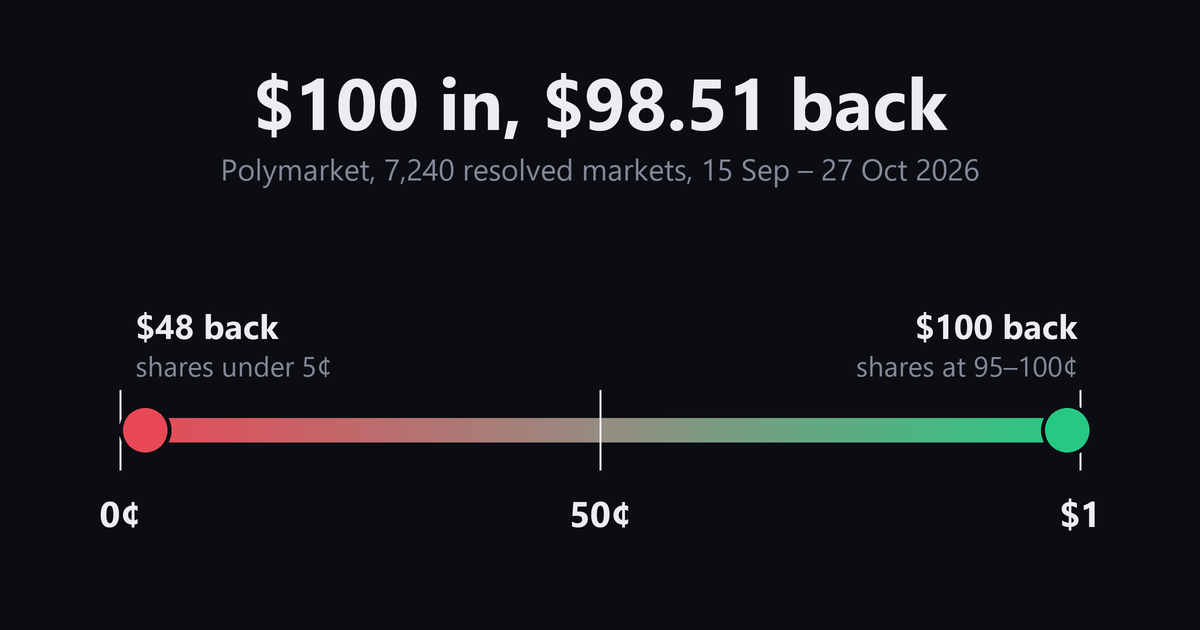
Out of every $100 that regular traders put into Polymarket markets that closed between 15 September and 27 October 2026, about $98.50 came back. Our 95% range is $95.60 to $100.80. Four in ten wallets ended ahead. On average fees took about 90 cents of every $100, and $1.60 to $1.80 in the short crypto "Up or Down" markets. Shares bought for less than 5¢ paid back about $48 per $100.
We counted this ourselves from public Polymarket data: 1.14 million positions held by 144,279 wallets in 7,240 resolved markets. Our main numbers come out close to a viral analysis published on X by the researcher Daru in October, even though we used a different method and a later six weeks. More on that below.
Do people make money on Polymarket?
Some do, most don't, and over a few weeks the split is close to 40/60.
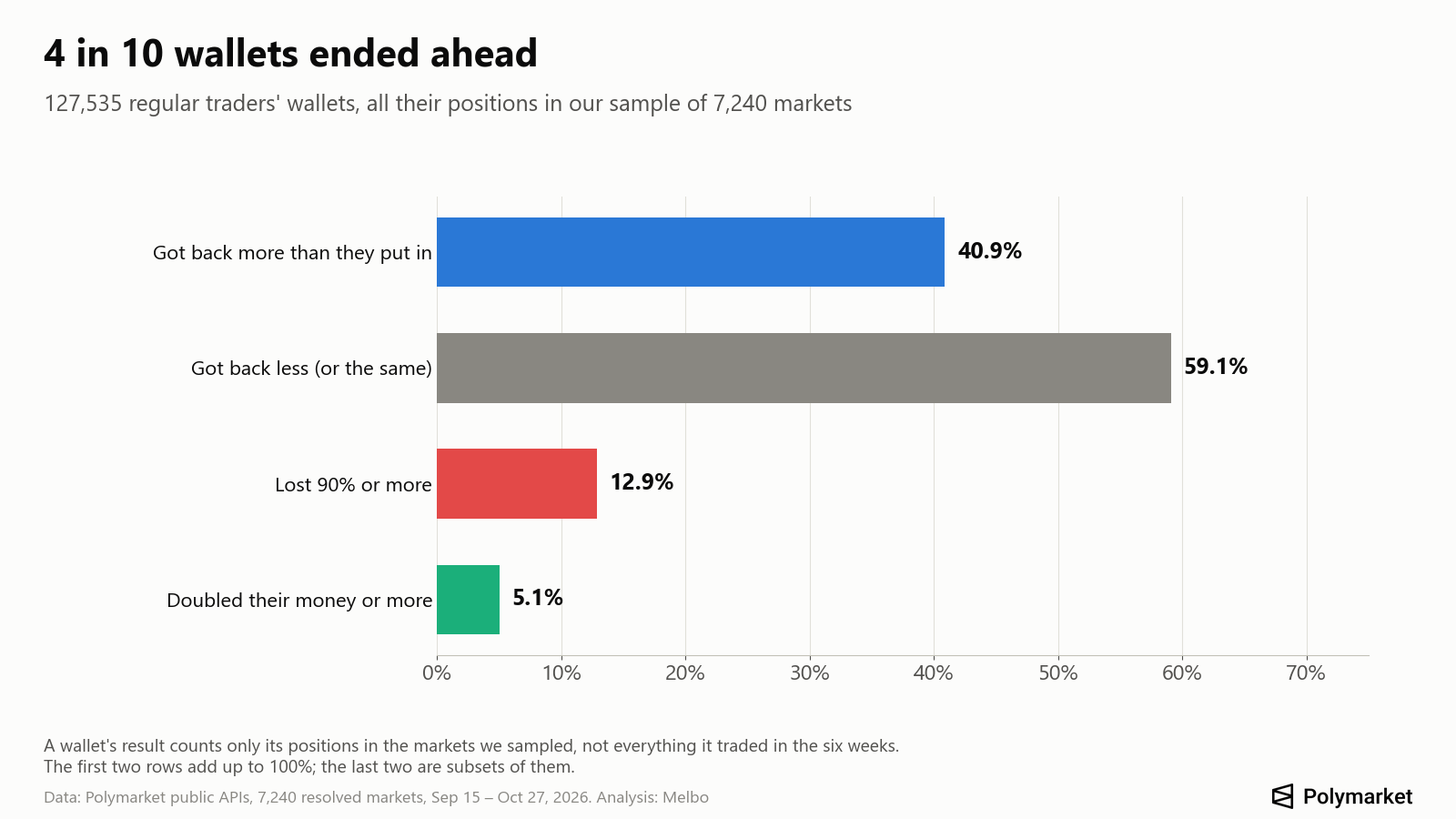
In our sample of 127,535 regular traders' wallets:
- 40.9% got back more than they put in;
- 59.1% got back less, or exactly the same;
- 12.9% lost 90% or more of what they put in;
- 5.1% doubled their money or better.
A wallet's result here covers only its positions in the markets we sampled, not everything it traded in those six weeks. Studies that follow wallets for longer find fewer winners, because a lucky month gets diluted:
| Study | Period | Share of accounts ahead |
|---|---|---|
| This analysis (7,240 markets) | 15 Sep – 27 Oct 2026 | 40.9% |
| Daru (21M fills, 328k wallets) | 8 Aug – 18 Sep 2026 | 39.0% |
| Telonex, 15-minute crypto markets, fees not counted | 2–8 Feb 2026 | 36.8% |
| Akey, Grégoire, Harvie, Martineau (588M trades) | Nov 2022 – Mar 2026 | about 30% |
| Andrey Sergeenkov (2.5M addresses) | Apr 2024 – Apr 2026 | 15.9% |
Sources: Daru, Telonex, Akey et al. dataset, Sergeenkov.
The long-run studies agree on a second point too: profits are concentrated. In the Akey et al. data the top 1% of profitable users took about 76.5% of all profits.
How much of every $100 comes back, by market type
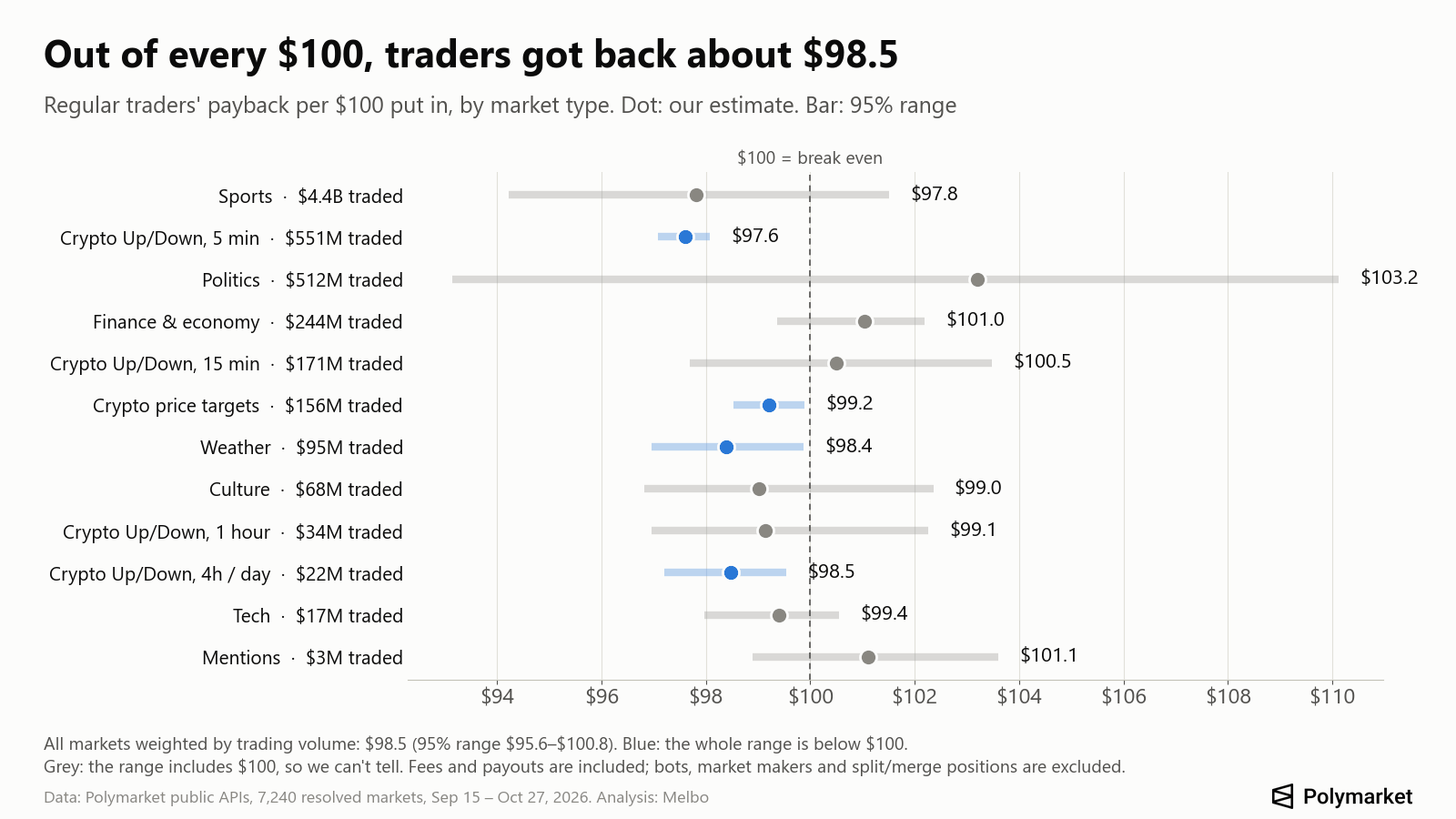
| Market type | Back per $100 | 95% range | Fees per $100 | Markets in sample |
|---|---|---|---|---|
| All markets, weighted by volume | $98.51 | $95.63–100.75 | $0.92 | 7,240 |
| Crypto Up/Down, 5 minutes | $97.60 | $97.10–98.10 | $1.62 | 1,500 |
| Crypto Up/Down, 15 minutes | $100.50 | $97.70–103.50 | $1.76 | 1,500 |
| Crypto Up/Down, 1 hour | $99.14 | $97.00–102.30 | $1.53 | 200 |
| Crypto Up/Down, 4 hours and daily | $98.48 | $97.20–99.50 | $1.16 | 150 |
| Crypto price targets | $99.21 | $98.50–99.90 | $0.77 | 300 |
| Sports | $97.82 | $94.20–101.50 | $0.91 | 1,999 |
| Politics | $103.20 | $93.10–110.10 | $0.19 | 800 |
Three things stand out.
The 5-minute crypto markets are the clearest case. They have the most positions in our sample (362,685), so the range is tight: $97.10 to $98.10. Before fees, traders there got back $99.22. Fees took $1.62 of every $100, which is about two thirds of what they lost. Daru found the same $97.60 for short crypto markets in his window.
Sports carries the most money. Sports markets were 70% of the $6.3 billion traded in markets that closed in our window. Our estimate there is $97.82, but sports results swing with a few large games, so the 95% range is wide.
Politics is too noisy to call. One large market can move the whole category, and our range runs from $93 to $110. We would not read anything into the $103.20.
What Polymarket fees cost per $100
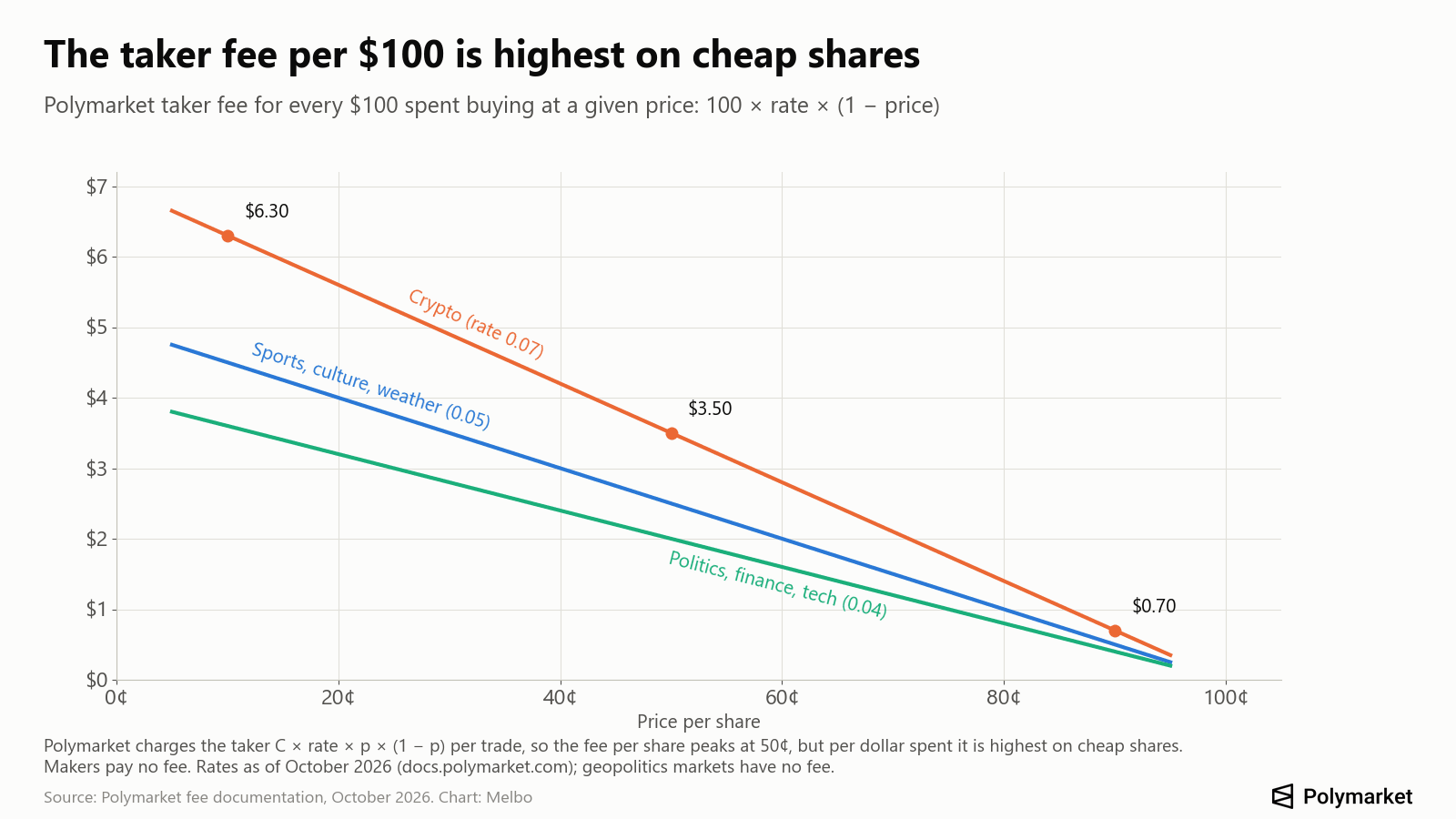
Polymarket charges a fee only to the taker, the side whose order fills against an order already on the book. The formula is `fee = shares × rate × price × (1 − price)` (Polymarket docs). Makers, whose limit orders were already waiting, pay nothing and get part of the fee back as a rebate.
| Category | Taker rate | Fee per $100 at 10¢ | at 50¢ | at 90¢ |
|---|---|---|---|---|
| Crypto | 0.07 | $6.30 | $3.50 | $0.70 |
| Sports, culture, weather, economics | 0.05 | $4.50 | $2.50 | $0.50 |
| Politics, finance, tech, mentions | 0.04 | $3.60 | $2.00 | $0.40 |
| Geopolitics | 0 | $0 | $0 | $0 |
Rates as of October 2026. The fee per share is largest at 50¢, which is how most guides describe it. Per dollar spent, though, the fee is 100 × rate × (1 − price), so it is largest on cheap shares. Buying a 10¢ crypto share costs $6.30 in fees on every $100, nine times as much as buying at 90¢.
Two details matter for the question people search most:
- There is no fee on payouts. Polymarket charges nothing when a market resolves and you redeem winning shares, and nothing on deposits or withdrawals of USDC. The fee is taken only when your order fills as a taker.
- Active takers get some of it back. Since 28 May 2026 a taker rebate program returns 3% to 50% of fees to wallets with at least $2,000 of weighted volume in 30 days (Polymarket docs). Our numbers do not include rebates, so for very active takers the true payback is slightly higher.
Fees have also risen this year. In January only 15-minute crypto markets charged a fee. Since 30 March 2026 almost every category does, and the sports rate went from 0.03 to 0.05 on 10 July 2026.
Where the missing $1.50 goes
Every share traded has a buyer and a seller, so before fees, what one side loses the other side gains. In our sample the difference went three ways:
- Fees. About 92 cents of every $100 that regular traders put in, and $1.60 to $1.80 in short crypto markets.
- The fastest wallets. 261 wallets placed more than 200 fills in a single hour at least once in our sample. Weighted the same way as everyone else, they got back $104.85 per $100.
- Market makers. Wallets with at least 90% of their fills as maker orders got back $99.68 per $100 before their rebates and liquidity rewards, which our data does not include.
This matches what longer studies find. In the Akey et al. data, winners tend to post limit orders and losers tend to take liquidity with market orders. On Kalshi, Jonathan Becker found takers losing 1.12% and makers gaining the same amount (Becker).
Cheap shares pay back the least
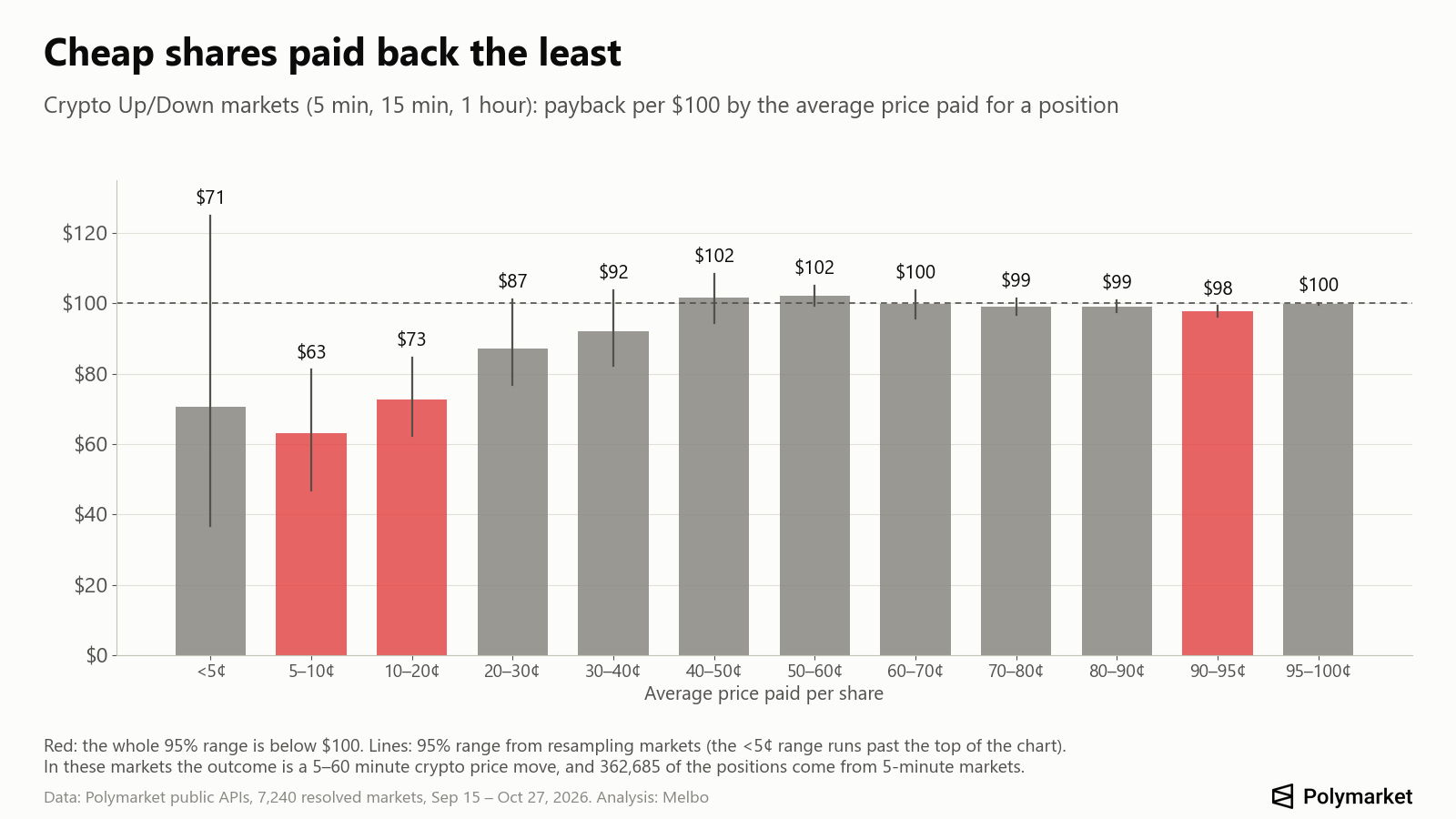
The price of a share is the market's estimate of the probability: 20¢ means about a 20% chance. If prices were perfectly fair and there were no fees, a share at any price would pay back $100 per $100 on average. In practice cheap shares paid back much less:
- Across all markets, positions bought at an average price under 5¢ paid back $48.20 per $100 (95% range $39.40–62.40). Their average price was 1.9¢, which implies a 1.9% chance, but they won 1.25% of the time.
- In short crypto markets, shares bought at 5–10¢ paid back $63 and shares at 10–20¢ paid back $73. Both ranges sit entirely below $100.
- Shares near certainty (95–100¢) paid back $100.10 per $100, with a range of $99.94 to $100.33.
This pattern has a name: the favorite-longshot bias. Long shots are overpriced, so buying them loses more on average, and the fee per dollar is also highest there. Other studies find the same direction. Cardozo and Rivero-Wildemauwe measured −19.35% on Polymarket shares under 10¢ and +0.83% on shares at 90¢ and above, with the bias strongest in crypto and politics and absent in sports (arXiv). On Kalshi, Bürgi, Deng and Whelan found that contracts at 10¢ or less lose more than 60% after fees (paper).
How likely is a 10x or a 100x?
Less likely than the price suggests. Among regular traders' positions in our sample:
- 6.8% got back at least twice what they put in;
- 0.13% got back 10 times or more, about 1 in 780;
- 0.0027% got back 100 times or more, about 1 in 36,500.
Positions bought at 1¢ or less won 83 times out of 12,299, or 0.67%. Only 22 of them reached 100x after fees and any early selling.
Small positions also did worse than large ones. Positions under $10 got back $97.10 per $100 and positions of $1,000–10,000 got back $101.50, without weighting by category. Small traders lean towards cheap shares and short crypto markets, where both the fee per dollar and the long-shot discount are highest.
How our numbers compare with Daru's
| Measure | This analysis | Daru |
|---|---|---|
| Window | 15 Sep – 27 Oct 2026 | 8 Aug – 18 Sep 2026 |
| Data | 7,240 sampled markets, 1.14M positions | all fills, 21M |
| Back per $100, regular traders | $98.51 (range $95.63–100.75) | $98.45 |
| Short crypto Up/Down markets | $97.60 (5-minute) | $97.60 |
| Wallets ahead | 40.9% | 39.0% |
| Lost 90% or more | 12.9% | 11.7% |
| Doubled or more | 5.1% | 2.5% |
Daru rebuilt every fill on the chain. We took a random sample of markets in each category and weighted the categories back by their real trading volume. The two estimates agree within a few tenths of a dollar. Daru's analysis also covers memecoins on pump.fun, where regular traders got back $75.36 per $100 over his six weeks.
What this means if you trade prediction markets
None of this predicts what any single trade will do. It shows where the average costs sit:
- Look at the fee per dollar, not per share. At 10¢ in a crypto market the fee is $6.30 per $100; at 50¢ it is $3.50.
- Know whether your order is a taker or a maker order. Takers pay the fee; makers pay none and receive part of it as a rebate.
- Long shots are priced against you on average. In our sample, shares under 5¢ cost 1.9¢ on average and won 1.25% of the time.
- Short crypto markets cost the most. They carry the highest fee rate, and you pay it again on every round trip.
- A few weeks is a small sample. In our data 41% of wallets came out ahead over six weeks. Studies that follow wallets for two or three years find 16–30%.
For a basic explanation of prices and payouts, see how prediction markets work. Our earlier analyses of Polymarket trading bots and 5-minute markets and prediction market prop firms go deeper into fees and short-term markets.
Frequently asked questions
Do people make money on Polymarket?
Some do. In our sample of markets that closed between 15 September and 27 October 2026, 40.9% of regular traders' wallets ended ahead, and as a group they got back about $98.50 of every $100. Over longer periods fewer wallets come out ahead: 16–30% in studies covering two to three years.
What percentage of Polymarket traders are profitable?
It depends on the period. Over six weeks we found 40.9%, and Daru found 39% for the six weeks before ours. Andrey Sergeenkov found 15.9% for April 2024 to April 2026, and Akey et al. about 30% from 2022 to March 2026.
How much does Polymarket charge in fees?
Only takers pay: shares × rate × price × (1 − price). The rate is 0.07 for crypto, 0.05 for sports, culture, weather and economics, 0.04 for politics, finance, tech and mentions, and 0 for geopolitics. Per $100 spent, that is $3.50 at 50¢ in a crypto market and $6.30 at 10¢.
Does Polymarket charge a fee when you win?
No. There is no fee on payouts, redemptions, deposits or withdrawals. The fee is charged only when your order fills as a taker.
Which Polymarket markets have the highest fees?
Crypto markets, with a rate of 0.07. In our sample fees took $1.62 of every $100 in 5-minute crypto Up/Down markets and $1.76 in 15-minute ones, against $0.91 in sports and $0.19 in politics.
Do cheap shares pay off on Polymarket?
On average, no. Shares bought under 5¢ paid back about $48 per $100 in our sample, and shares at 1¢ or less won 0.67% of the time. Shares near certainty, at 95–100¢, paid back about $100.
What is the favorite-longshot bias?
It is the tendency for unlikely outcomes to be priced too high and likely ones slightly too low. It shows up on Polymarket and Kalshi, and it is strongest in crypto and politics markets.
Who makes money on Polymarket?
Mostly the fastest and most active wallets, and market makers who post limit orders and earn rebates. In our sample, 261 high-frequency wallets got back $104.85 per $100, while regular traders got back $98.51.
How we counted
We listed every Polymarket market with an end date between 15 September and 27 October 2026 and at least $500 traded: 209,005 markets, with $6.3 billion in lifetime volume. From the 207,951 binary markets with a clear result, we drew a random sample in each of 12 categories, 7,240 markets in total, and downloaded every fill from Polymarket's public data API, marking which side was the taker.
A position is one wallet in one market. What went in is the cost of its buys. What came back is the proceeds of its sales, plus $1 for every winning share still held at resolution, minus taker fees at the market's own rate. "Back per $100" is 100 × everything that came back ÷ everything that went in. We wrote these rules down before counting.
Regular traders exclude three groups: wallets with more than 200 fills in any hour, wallets with at least 90% maker fills, and positions where a wallet sold more shares than it bought, which means it created shares through a split. Category results are weighted by each category's real trading volume. The 95% ranges come from resampling whole markets, because positions in the same market share one outcome.
What this cannot show: rebates and liquidity rewards; trades in markets that closed after 27 October; and each wallet's full history outside our sample. After a first pass on 2,940 markets gave a wide range, we enlarged the samples of the four largest categories. The first-pass estimate was $98.04.